





Why Willpower Fails for Weight Loss
Willpower feels strong at the start of a diet, then weaker when life gets busy. You may begin with discipline, skip tempting foods, track meals carefully, and feel in control for a few days. Then stress, hunger, tiredness, or one difficult evening can undo the plan.
This article explains why willpower fails for weight loss, what most people misunderstand about motivation, and what works better: a repeatable system. You will learn how habits, food logging, progress review, and lower-friction routines can support consistency without turning every meal into a test.
SlimAI Calorie Tracker helps users work toward weight management with AI Calorie Tracker, Flexible Food Logging, Custom Calorie Goals, Macro Tracker, and Progress, Streaks & Back-Date Logging.
What is willpower in weight loss?
Willpower in weight loss is the effort to resist short-term food temptations so you can follow a longer-term goal. The American Psychological Association describes willpower as the ability to resist short-term temptations to meet long-term goals. (apa.org)
Why willpower fails for weight loss is not because people are weak. It fails because weight management involves repeated decisions across meals, snacks, hunger, emotions, social settings, and daily routines.
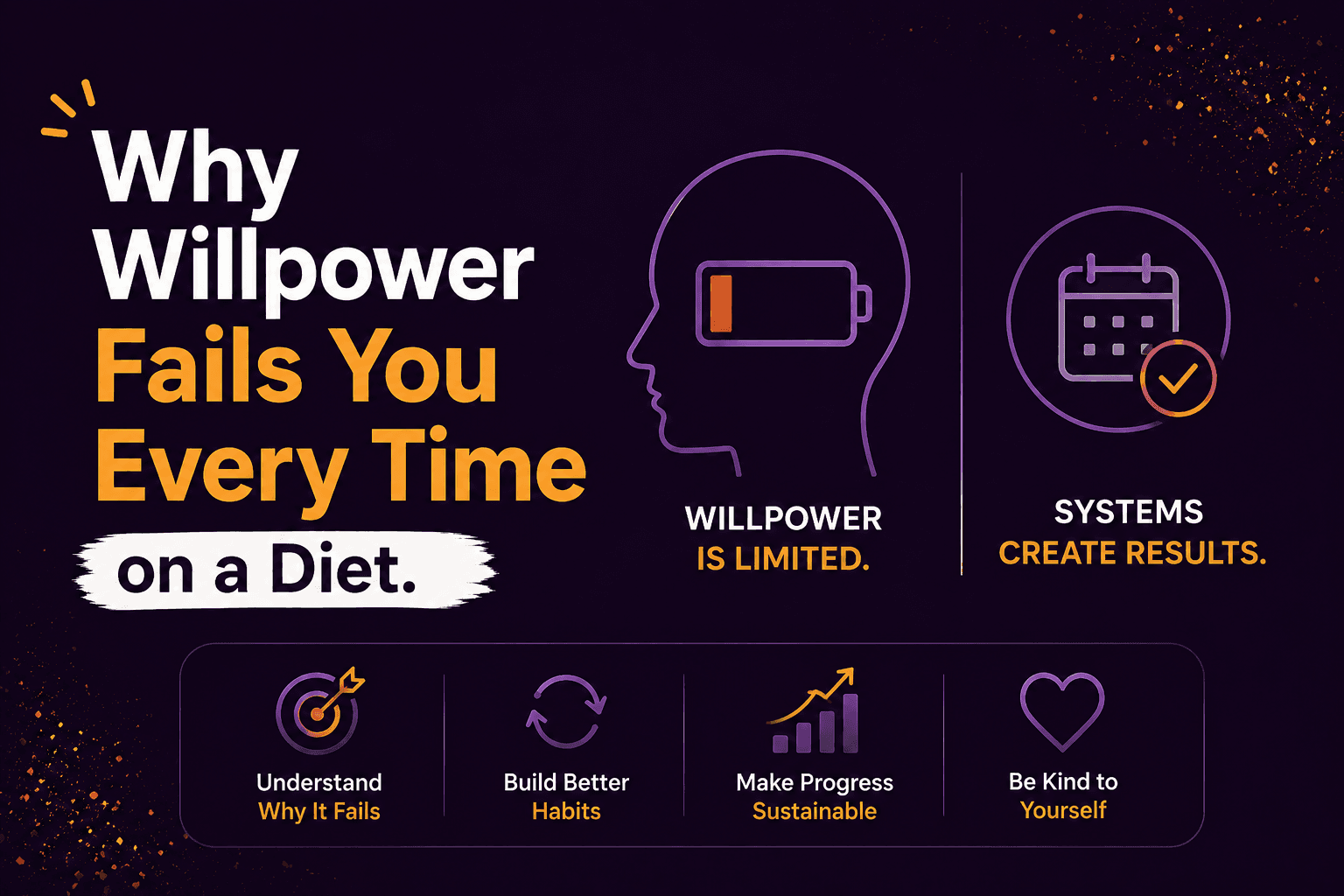
A weight-loss system works differently. It reduces the number of moments where you need willpower at all.
Why does willpower fail when you are trying to lose weight?
Willpower fails because weight loss is not one decision. It is many small decisions repeated across normal days.
You may feel motivated in the morning, then tired by evening. You may plan a balanced meal, then get stuck with limited options. You may track breakfast and lunch, then skip dinner logging because the day feels messy.
That is normal behavior, not a personal flaw.
Willpower also competes with hunger, stress, convenience, social pressure, sleep, and emotions. If your whole plan depends on being mentally strong at every meal, the plan becomes fragile.
This is why many people get stuck in restart mode. They do well for a few days, have one difficult moment, feel disappointed, and decide to begin again later.
A better question is not “How do I become more disciplined?” A better question is “How do I make the next good choice require less force?”
What do most people get wrong about willpower and dieting?
They treat every meal like a character test
Food choices are not proof of character. A higher-calorie meal, craving, or missed log does not mean you lack discipline. It means your routine needs more support.
When every meal becomes a pass-or-fail test, dieting feels exhausting. That pressure often leads to all-or-nothing thinking.
They assume motivation should stay high
Motivation is useful at the beginning. It helps you start. But motivation changes quickly because your mood, schedule, hunger, and stress change.
Expecting motivation to stay high every day makes weight loss feel harder than it needs to be.
They build plans for perfect days
Many diet plans only work when meals are prepared, sleep is good, stress is low, and nothing unexpected happens. Real life rarely works that way.
A better plan should survive social meals, busy workdays, imperfect logs, and normal fluctuations.
What actually works better than willpower?
A system works better than willpower because it makes useful actions easier to repeat. Behavior design research from BJ Fogg explains that behavior happens when motivation, ability, and a prompt come together at the same time. If a behavior feels too difficult, it needs more motivation to happen. (behaviordesign.stanford.edu)
For weight loss, that means the goal is not to force harder choices. The goal is to make useful choices more available.
NHS weight-loss guidance emphasizes practical habits such as setting goals, planning meals, making healthier food choices, getting more active, and recording activity and progress. (nhs.uk)
Self-monitoring also matters. Burke et al. describe self-monitoring as central to behavioral weight-loss interventions, including monitoring diet, exercise, and weight. (pmc.ncbi.nlm.nih.gov)
The practical approach is clear: create a routine that reduces friction. Track enough to see patterns. Review progress over time. Build habits that can continue when motivation is low.
How SlimAI Calorie Tracker helps when willpower fails
SlimAI Calorie Tracker helps reduce the pressure of relying on memory, motivation, or perfect discipline. When tracking feels hard, SlimAI gives you several ways to log food through Flexible Food Logging, including Type to Add, Voice to Log, Camera Scan, Gallery Upload, Food Database Search, Recent Foods, Saved Foods, and Back-Date Logging.
If calorie decisions feel unclear, Custom Calorie Goals and Macro Tracker help you review calories, protein, carbs, and fats in context. If one day feels messy, Progress, Streaks & Back-Date Logging helps you return to the pattern instead of judging one moment.
AI calorie estimates can vary because of portion size, ingredients, sauces, cooking methods, and serving size. SlimAI reduces this friction with Ingredient Editing and Serving Size Guidance, helping users adjust entries closer to what they actually ate.
Explore the most relevant feature: /features/flexible-food-logging
How do you build a weight-loss system that does not rely on willpower?
Start with one repeatable food-tracking habit
Pick one meal to track first. Breakfast often works because it usually happens in a predictable window. Once that feels normal, add another meal instead of forcing a full-day system from the beginning.
Reduce decisions before hunger gets intense
Plan one or two default meals that fit your routine. This removes pressure when you are tired or rushed. A default meal does not need to be strict; it needs to be repeatable.
Use tracking as information, not judgment
A food log should show what happened, not decide whether you were “good” or “bad.” Use calorie balance, macros, and meal patterns to learn what supports your routine.
Review progress weekly instead of emotionally
Daily weight and food choices can feel noisy. A weekly view gives better context. Look for patterns in meals, activity, hunger, and consistency before making changes.
Build recovery into the system
A missed meal log or higher-calorie day should not end the plan. Use Back-Date Logging when needed, return to your next normal meal, and keep the system moving.