





Body Fat Percentage vs BMI vs Weight: What Matters?
Your scale says you lost weight. Your BMI moved into a “healthy” category. Yet your body looks or feels almost unchanged. Another person sees the opposite: their weight stays flat, but their clothes fit better and their strength improves.
These conflicting signals cause much of the confusion around body fat percentage vs BMI vs weight. Reddit discussions from the past five years repeatedly ask whether a normal BMI can hide high body fat, whether muscle gain can mask fat loss, and whether smart-scale body-fat readings mean anything.
This guide explains what each number measures, what losing it means, and how to build a clearer progress picture without allowing one estimate to control your decisions.
What Do Weight, BMI, and Body Fat Percentage Actually Measure?
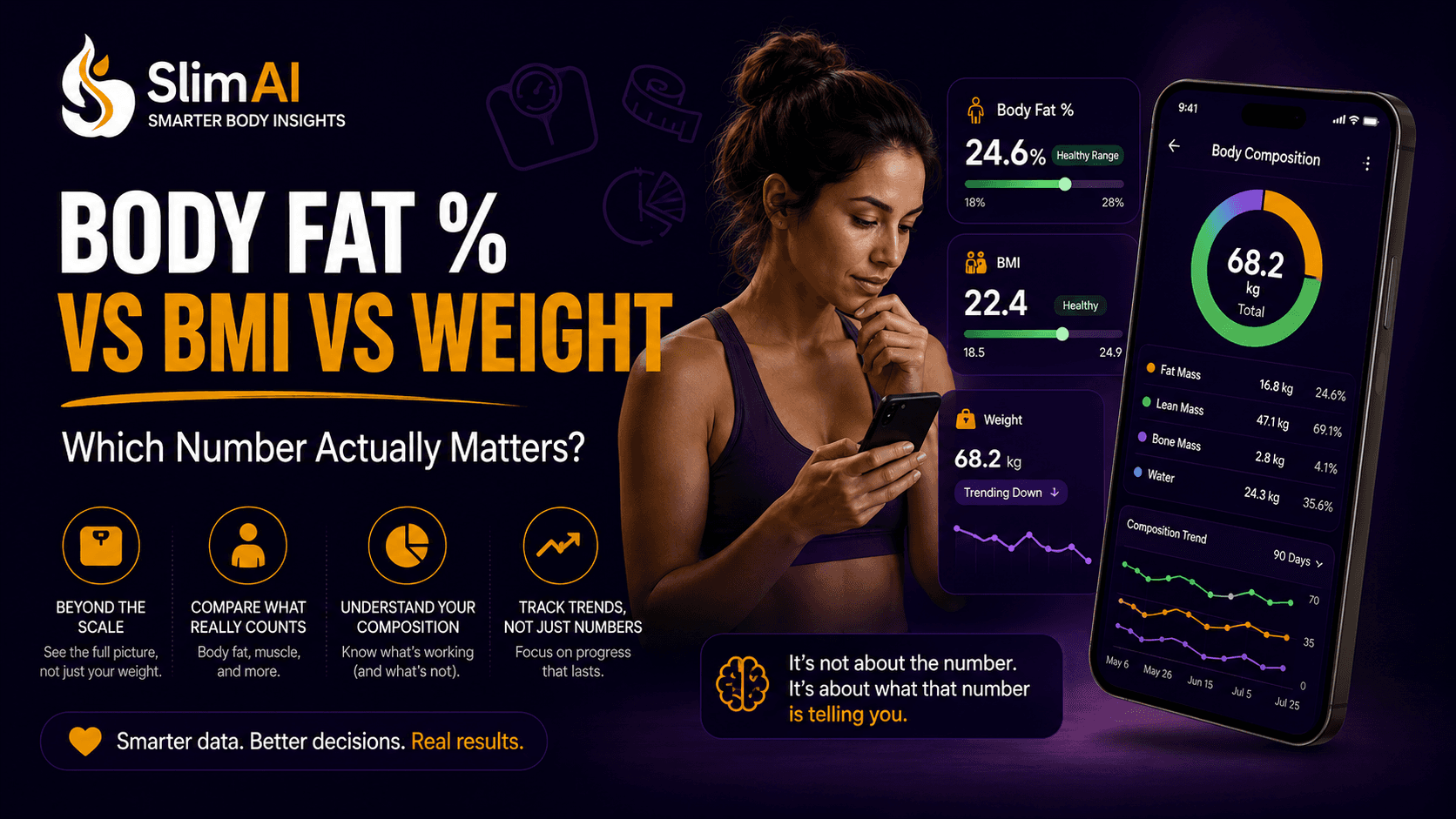
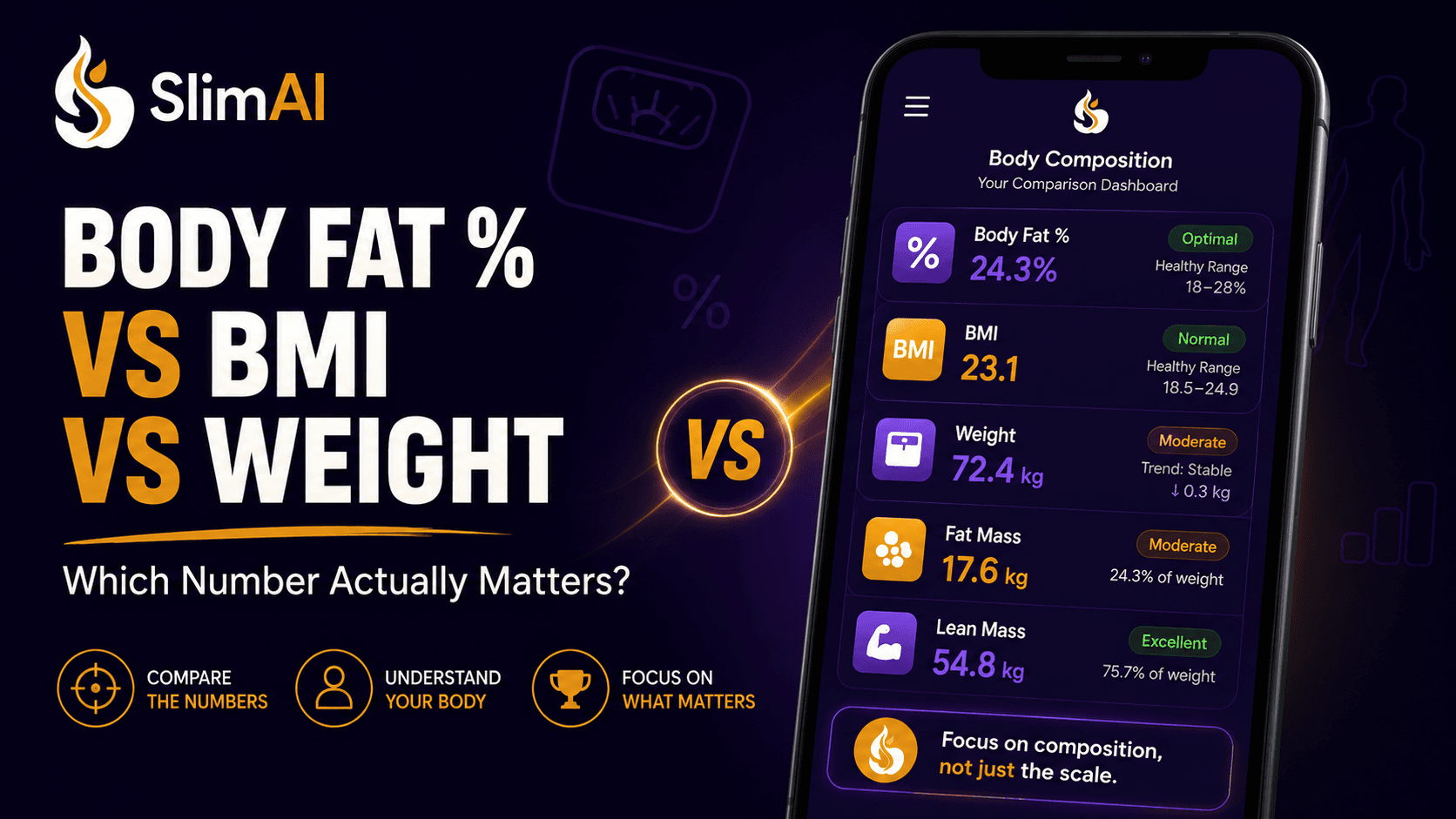
Weight, BMI, and body fat percentage describe different parts of your body. Weight measures total mass. BMI compares that weight with your height. Body fat percentage estimates the proportion of your total weight that comes from fat.
Metric | What it tells you | What a decrease may mean | What it cannot tell you |
Weight | Your total body mass | Less fat, muscle, water, food, glycogen, or a combination | Which tissue changed |
BMI | Whether your weight is relatively high or low for your height | You moved into a different weight-to-height category | Whether the change came from fat or muscle |
Body fat percentage | The estimated share of your weight stored as fat | Fat became a smaller share of your total mass | Exact health status or an exact amount without uncertainty |
Fat mass | Estimated total weight of body fat | You may have lost stored fat | Where all fat was lost |
Lean mass | Everything that is not fat, including muscle, water, organs, and bone | A drop may reflect muscle, water, or other fat-free tissue | Muscle mass alone |
The CDC explains that BMI does not distinguish fat, muscle, or bone mass. It also does not show where fat is stored.
Why Do Weight, BMI, and Body Fat Numbers Disagree?
The numbers disagree because they answer different questions.
A person can have a higher BMI because of greater muscle mass. Someone else can fall within the same BMI category while carrying less muscle and more fat. The National Heart, Lung, and Blood Institute therefore describes BMI as one part of a wider assessment rather than a complete description of body composition.
This explains a common Reddit concern: “My BMI is healthy, so why do I still have a high body-fat percentage?” A recent r/loseit discussion correctly focused on body composition and resistance training rather than encouraging the user to chase a much lower scale weight.
The reverse can happen too. A muscular person may have a BMI in the “overweight” range without having unusually high body fat. The CDC treats BMI as a screening measure and recommends interpreting it with health history, behavior, physical findings, and other indicators.
A 2025 Lancet commission reached a similar conclusion: BMI can both underestimate and overestimate body fat at the individual level. The commission recommended considering direct fat measurements or measures such as waist circumference alongside signs of health and physical function.
What Does Losing Weight, Fat, or Muscle Actually Mean?
Losing Weight Means Your Total Mass Decreased
A lower scale reading does not automatically mean you lost the same amount of fat.
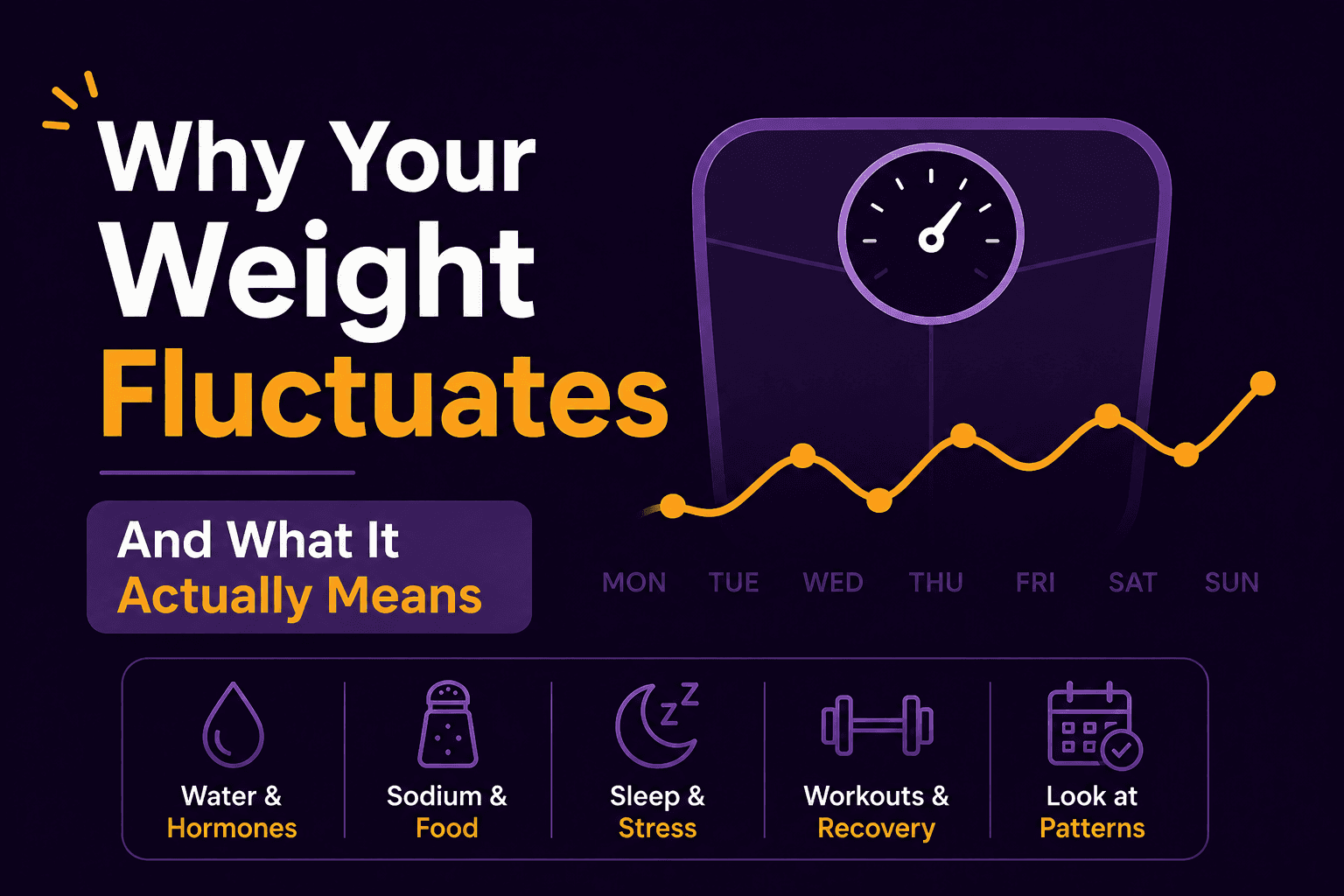
Body weight includes fat, muscle, water, stored carbohydrate, bone, organs, and digestive contents. A short-term change may come largely from water or food weight. A longer trend can provide more useful context, but it still cannot identify which tissue changed.
Losing Fat Means Your Fat Mass Decreased
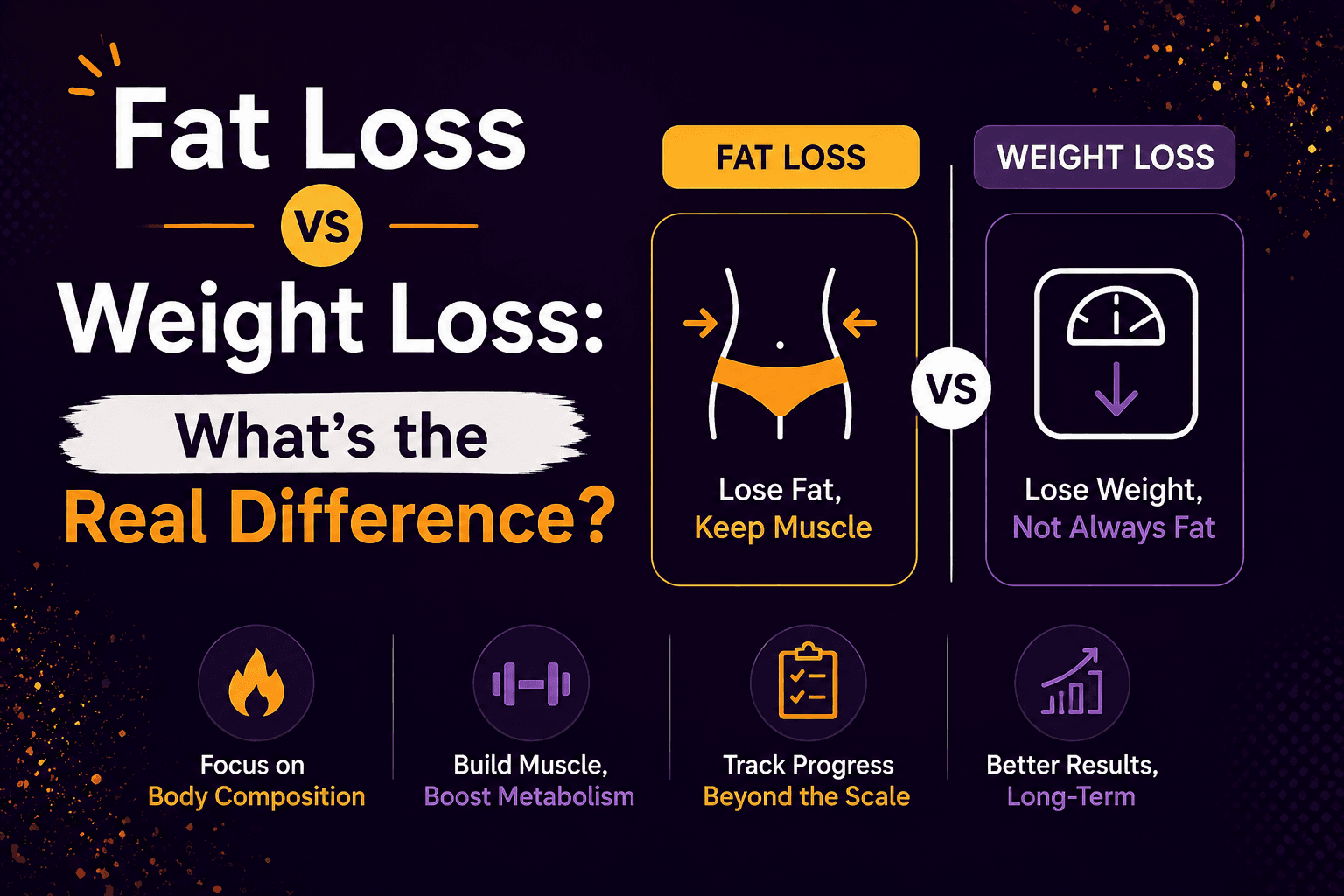
Fat loss means the amount of fat stored in your body became lower. Your weight will often decrease, but not always at the same rate.
During body recomposition, fat mass may fall while lean mass rises or remains stable. That can leave scale weight almost unchanged. Reddit users often describe this as clothes fitting better while the scale appears “stuck,” which is why measurements, photos, and strength trends can add useful context.
Losing Muscle Means Part of Your Lean Tissue Decreased
Lean-mass loss is not identical to muscle loss because lean mass also includes water, bone, organs, and other fat-free tissue.
However, rapid weight loss, inadequate nutrition, inactivity, or an unsuitable training plan can make muscle retention harder. This is why the goal is often not merely to make weight fall. It is to reduce fat while maintaining useful lean tissue, strength, energy, and recovery.
What Do People Get Wrong About Body-Composition Numbers?
“A Healthy BMI Means My Body Composition Must Be Healthy”
BMI provides useful population-level and screening information, but it cannot confirm your personal fat or muscle levels.
A study of more than 6,000 adults found that BMI categories missed some people with elevated body fat and related cardiometabolic risk factors. That does not make BMI useless. It means BMI should not be interpreted alone.
“If My Weight Is Not Falling, I Am Not Losing Fat”
Stable weight can sometimes occur during body recomposition, but it should not become an automatic explanation for every plateau.
Look for supporting evidence: waist or circumference changes, body-fat trends, improved strength, consistent photos, and fit of clothing. If none of these move over time, your current routine may not be creating the intended change.
“My Smart Scale Gives an Exact Body-Fat Measurement”
Most consumer smart scales use bioelectrical impedance and prediction equations. Hydration, recent food, exercise, body position, device design, and the population used to build the equation can affect the result.
This uncertainty appears frequently in Reddit threads where users report large changes between devices or readings that follow scale weight without matching visible progress.
The practical lesson is not to search for a magically exact home number. Use a transparent method, consistent conditions, an honest likely range, and repeated trends.
Which Number Matters Most for Your Goal?
No single number matters most for every goal.
Your goal | Most useful information | Why |
General weight screening | BMI, weight, waist, medical context | BMI provides a quick starting point but needs context |
Fat loss | Fat mass, body-fat trend, waist, weight trend | Shows whether weight change is likely coming from fat |
Body recomposition | Fat mass, lean mass, strength, photos, measurements | Scale weight may change slowly or remain similar |
Muscle gain | Lean-mass trend, training performance, weight trend | Helps separate useful growth from rapid fat gain |
Fitness progress | Strength, endurance, recovery, body composition | Fitness cannot be reduced to body size |
Health assessment | Clinical history, labs, blood pressure, waist, body composition | No consumer estimate can diagnose health |
For everyday fitness progress, body fat percentage often provides more context than weight or BMI alone. It still works best beside fat mass, lean mass, waist changes, strength, and how you feel.
Where fat is stored can also add context. Research has linked fat distribution with metabolic differences, and abdominal measurements are commonly used alongside BMI.
What Body Fat Percentage Is Considered Healthy?
There is no single healthy body-fat percentage that applies to every adult.
Reference ranges differ by age, sex-related physiology, population, measurement method, and the purpose of the assessment. Gallagher and colleagues developed provisional age- and sex-informed ranges that corresponded with established BMI categories, but the authors presented them as guidelines rather than universal personal targets.
This is why a generic chart can be misleading. A body-fat estimate should be considered beside your age, formula set, confidence range, fat distribution, physical function, and health context.
Extremely low body fat is not automatically better. Your body requires essential fat for normal functions, and an aggressive target may not support energy, hormones, training, recovery, or a healthy relationship with food.
How Can You Lose Fat While Maintaining Muscle?
Fat loss while maintaining muscle usually requires a measured approach rather than the largest possible calorie deficit.
Use a Sustainable Calorie Target
A calorie deficit may support fat loss, but an unnecessarily aggressive target can make training, hunger, and recovery harder to manage. Your target should reflect your body, activity, goal, and health needs.
Keep Resistance Training in Your Routine
Resistance training gives your body a reason to maintain muscle while weight is changing. Recent evidence reviews support resistance exercise as an important part of higher-quality weight loss because it can help preserve or improve fat-free mass.
Eat Enough Protein for Your Needs
Protein supports the structure and repair of body tissues. A 2024 meta-analysis found that higher protein intake can help adults with overweight or obesity retain more muscle during weight loss, although personal needs vary.
Judge Trends, Not One Day
Compare several weeks of weight, body composition, waist, photos, and training performance. A single reading can be distorted by hydration, clothing, timing, or measurement conditions.
A 2023 r/bodyweightfitness thread asking how to lose fat while maintaining muscle reached a useful broad direction: lose at a manageable pace, maintain appropriate protein, and continue resistance training. Those community responses align with current evidence, but personal nutrition advice should come from a qualified professional when health conditions are involved.
How Does SlimAI Body Assessment Show What Weight Misses?
SlimAI Calorie Tracker addresses the central problem behind this comparison: weight and BMI cannot show whether your body is changing through fat, lean mass, or both.
SlimAI Body Assessment uses two guided smartphone photos; one from the front and one from the left side to estimate six tape-style measurements: neck, chest, upper arm, abdomen, hips, and thigh.
Your results include estimated body fat percentage with a likely range, fat mass, lean mass, an age- and sex-parameter-adjusted ideal range, and a High, Moderate, or Low confidence rating. A regional breakdown shows estimated fat distribution across the neck, chest, upper arms, abdomen, hips and waist, thighs, and the rest of the body.
Every result remains an estimate with roughly ±3–4 percentage-point uncertainty. If loose clothing, framing, lighting, or pose reduces reliability, SlimAI lowers the confidence rating and explains how to improve the next scan rather than presenting false precision.
Voice guidance and auto-capture help you repeat the same stance without holding the phone. If you prefer not to use photos, Enter Measurements mode lets you provide the same six tape measurements and receive the same type of results screen without creating or uploading an image.
Scan History, Body Fat Trend, and Compare mode help you see whether fat mass and lean mass are changing across weeks or months. That turns Eat smarter, not stricter. into something measurable: your progress is no longer judged by scale weight alone.
Body Assessment analysis, manual measurement entry, and unlimited assessments are available with SlimAI Pro. SlimAI can then connect your results with a personalized diet plan, daily calorie target, food tracking, exercise, water, fasting, weight, and step data in one broader feedback loop.
How Should You Track Body-Composition Progress?
1. Decide What You Are Trying to Change
Choose whether your main goal is lower weight, lower fat mass, maintained muscle, improved strength, or body recomposition.
Your goal determines which numbers deserve attention. Someone building muscle should not judge progress using scale loss alone.
2. Record a Starting Baseline
Record weight, body-fat estimate, fat mass, lean mass, waist or body measurements, and a consistent progress photo.
Treat this as a starting estimate, not a final judgment about your body.
3. Repeat Measurements Under Similar Conditions
Use similar clothing, pose, lighting, time of day, and device setup.
Consistency does not remove every limitation, but it makes trend comparisons more meaningful.
4. Compare Changes Across Several Signals
Look for agreement between body-fat trend, waist changes, weight, strength, clothing fit, and photos.
One unusual reading should not outweigh several weeks of consistent evidence.
5. Adjust Your Plan, Not Your Self-Worth
If fat mass is falling while strength remains stable, your plan may be moving in the intended direction. If lean mass, energy, and training performance fall quickly, reconsider the size of your deficit and seek qualified guidance.