


 free toolsno signup needed
Free Health and Nutrition Calculators
Calculators for the questions every weight-loss, weight-gain, or maintenance plan starts with — body mass index, body fat, daily calorie burn, macros, protein and water — plus the ones that come next: when you will reach your goal, your fasting window, what your steps burn, bulking and keto macros, FFMI and waist ratios. Free, no signup, and everything runs in your browser.
Each one answers a different question, and together they answer the whole first day of a plan: where you are now, what your weight is made of, how much you burn, what to eat, and how much to drink.
Nothing here is stored. Work out the numbers, use them, close the tab. When you want them to follow you week to week — recalculated as your body changes, and counted against every meal you eat — that is what the app is for.

3-day free trial · Cancel anytime · No card charged during trial
BMI Calculator
Enter your height and weight. Nothing is uploaded and nothing is stored — the maths runs in your browser.
Your BMI
25.5
Overweight · 25.0 – 29.9What this means
Body weight is above the healthy-weight band. A modest, steady calorie deficit is the usual starting point — not a crash diet.
Work out your maintenance calories first, then take a moderate deficit off it. A 0.5 kg per week pace is the one most people actually hold.
This number changes every week. SlimAI keeps it current.
Sign up once and SlimAI stores your height, weight, and BMI history, recalculates your healthy range as you go, and adds an AI body-fat estimate BMI cannot give you.

3-day free trial · Cancel anytime · No card charged during trial
BMI is a screening ratio, not a body-composition measurement. It cannot tell muscle from fat, and it reads high for muscular people and low for people carrying little lean mass. It is not medical advice.
Every Calculator, by the Question It Answers
Where am I now?
What should I eat, and when will I get there?
TDEE Calculator
Get maintenance calories plus a goal-adjusted daily target, from BMR to deficit.
Open calculator →Weight Loss Date Calculator
Your goal date at the pace you choose, and how much later it gets if calories never change.
Open calculator →Weight Loss Percentage Calculator
The percentage of body weight you have lost, progress to your goal, and your 5% and 10% marks.
Open calculator →Bulking Calculator
Lean, standard or aggressive bulk calories, macros in grams, and the rate to gain at.
Open calculator →What should those calories be made of, and when?
Macro Calculator
Convert calories into daily protein, carb, and fat grams, with a protein sanity check.
Open calculator →Protein Calculator
Daily protein target in grams, by body weight, goal and training day.
Open calculator →Keto Calculator
Keto macros in grams from a carb limit and your body weight, plus net carbs from a label.
Open calculator →Intermittent Fasting Calculator
When your fast ends and your eating window closes, from 14:10 to OMAD, plus 5:2.
Open calculator →Water Intake Calculator
Get a daily fluid target from weight, age, training, and climate — in glasses or bottles.
Open calculator →What does my walking add up to?
Numbers on a page, or one profile that keeps them current.
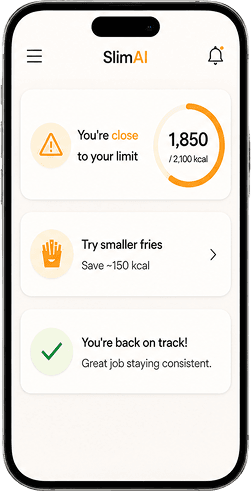
SlimAI stores your targets, recalculates them as your body changes, and counts every meal against them.
3-day free trial · Cancel anytime · No card charged during trial
Short Answers, One per Calculator
How do you calculate BMI?
BMI is your weight in kilograms divided by the square of your height in metres (kg/m²). For adults, the WHO classifies a BMI under 18.5 as underweight, 18.5–24.9 as a healthy weight, 25.0–29.9 as overweight, and 30.0 or above as obesity. BMI is a screening ratio, not a body-composition measurement: it cannot separate fat from muscle.
- Formula: BMI = weight (kg) ÷ height (m)²
- Imperial: BMI = 703 × weight (lb) ÷ height (in)²
- Healthy adult range: 18.5 to 24.9
- BMI does not measure body fat, and reads high for muscular people
How do you calculate body fat percentage?
The most practical method without a lab is the US Navy circumference formula, which estimates body fat percentage from height, neck, and waist for men, plus hips for women. For a man: %BF = 495 / (1.0324 − 0.19077 × log10(waist − neck) + 0.15456 × log10(height)) − 450, using centimetres. Multiply your body fat percentage by your weight to get fat mass; whatever is left is lean mass. The US Navy method has a published standard error of about 3.5 percentage points against hydrostatic weighing, so treat any single reading as a range rather than an exact figure.
- US Navy method needs height, neck, and waist — plus hips for women
- Fat mass = weight × (body fat % ÷ 100); lean mass = weight − fat mass
- Healthy range is roughly 14–24% for men and 21–31% for women
- Circumference formulas estimate body fat, they do not measure it
What is TDEE and how is it calculated?
TDEE (total daily energy expenditure) is the number of calories you burn in a day, including everything you do. It is calculated by working out your BMR — the calories you burn at complete rest — and multiplying it by an activity factor from 1.2 for sedentary to 1.9 for extra active. Eating at your TDEE holds your weight; eating below it loses weight; eating above it gains weight.
- BMR via Mifflin-St Jeor, or Katch-McArdle if you know your body-fat percentage
- TDEE = BMR × activity multiplier (1.2 to 1.9)
- A deficit of about 550 kcal a day is roughly 0.5 kg of fat a week
- Estimates, not measurements — adjust against real results after 2–3 weeks
How do you calculate macros?
Start from your daily calorie target, choose a percentage split across protein, carbohydrate, and fat, then convert each share into grams — protein and carbohydrate provide 4 calories per gram, fat provides 9. A common balanced split for fat loss is 30% protein, 40% carbohydrate, 30% fat, and most guidance puts protein between 1.6 and 2.2 g per kilogram of body weight.
- Protein: 4 kcal per gram · Carbohydrate: 4 kcal per gram · Fat: 9 kcal per gram
- Grams = (calories × share%) ÷ calories-per-gram
- Protein target: roughly 1.6–2.4 g per kg while losing fat
- Calories decide whether weight moves; macros decide what that weight is made of
How much protein do you need a day?
For healthy adults the useful range is 1.4–2.4 grams per kilogram of body weight a day, and where you sit in it depends on your goal: 1.6–2.4 g/kg while losing fat, 1.4–2.0 g/kg while maintaining, and 1.6–2.2 g/kg while gaining muscle. For a 78 kg adult losing fat that is roughly 125–187 grams a day. Adults from about 65 should not go below 1.2 g/kg.
- Losing fat needs the most, not the least — protein protects lean mass in a deficit and is the most filling of the three macros.
- Spread it across the day: three or four servings of 30–50 grams does more for muscle than one large serving.
- The range is per kilogram of body weight, so it scales with you rather than being one number for everyone.
- Kidney disease, liver disease and pregnancy change protein needs — those are clinical questions, not calculator questions.
How much water should you drink a day?
A common working guideline for healthy adults is 30–40 ml of total water per kilogram of body weight per day, which is about 2.3–3.1 litres for a 78 kg adult. Roughly 20% of that arrives through food, so the amount to actually drink is closer to 1.9–2.5 litres. Add about 350 ml for every 30 minutes of exercise, and more again in hot or humid conditions.
- Baseline: about 35 ml per kg of body weight for adults aged 31–55
- Around 20% of total water intake comes from food, not drinks
- Add roughly 350 ml per 30 minutes of sweating exercise
- Urine colour is the most practical day-to-day check: pale straw is the target
How long will it take to reach my goal weight?
Divide the weight you want to lose by your weekly pace. Losing 30 lb at 1 lb a week takes about 30 weeks, and at 1.5 lb a week about 20 — if your calorie target is recalculated as you lose. Eat the same calories the whole way and maintenance falls with your weight, so the same goal takes noticeably longer: about 37 weeks instead of 30 in the example below.
- The CDC suggests about 1–2 lb (0.5–1 kg) a week as a pace people are more likely to keep off.
- A smaller body burns fewer calories, so a fixed intake makes loss slow over time.
- Recalculating your target as your weight drops keeps the pace steady.
- Expect a faster first week — much of it is water — and an uneven line after that.
How do you calculate weight loss percentage?
Subtract your current weight from your starting weight, divide by your starting weight and multiply by 100. Going from 220 lb to 205 lb is 15 ÷ 220 × 100 = 6.8%. Losing 5–10% of starting weight is where the CDC says health benefits are likely to begin.
- Percentages make progress comparable between people of different sizes.
- 5% is the first milestone with likely health benefits; 10% is the second.
- Use a weekly average for current weight — single weigh-ins swing with water.
- Weight-loss challenges usually rank by percentage for exactly this reason.
How do you calculate an intermittent fasting window?
Add your plan's fasting hours to the time of your last meal. On 16:8, a last meal at 8:00 PM means the fast ends at 12:00 PM the next day, and you eat between 12:00 PM and 8:00 PM. The same 8:00 PM finish ends a 14:10 fast at 10:00 AM and a 20:4 fast at 4:00 PM.
- Most of a 14:10 or 16:8 fast happens while you sleep, which is why those are the usual starting points.
- Water, black coffee and plain tea do not break a fast. Anything with calories does.
- Fasting changes when you eat, not what the day adds up to. Weight loss still comes from the calorie deficit.
- 5:2 and 6:1 work differently: normal eating most days, and about 500 calories on fasting days.
How many calories do 10,000 steps burn?
Roughly 200 to 450 calories for most adults, depending mainly on body weight and stride length. A 175 cm (5 ft 9 in), 80 kg (176 lb) adult covers about 7.3 km (4.5 miles) in 10,000 steps and burns about 330 calories from the walking itself. A 163 cm (5 ft 4 in), 68 kg (150 lb) adult burns about 260.
- Body weight matters most: the same 10,000 steps cost a heavier person more energy.
- Taller people take longer strides, so they cover more distance with each step.
- These are calories from the walking itself, on top of what you burn at rest.
- Brisk walking, about 100 steps a minute, is roughly moderate-intensity exercise.
How many miles is 10,000 steps?
About 4 to 5 miles (6.3–8 km) for most adults, depending on height. At 5 ft 8 in (173 cm) it is about 4.5 miles; at 5 ft 4 in (163 cm) about 4.2 miles; at 6 ft 0 in (183 cm) about 4.7 miles. Most people take 2,000–2,500 steps per mile.
- Taller people take longer strides, so they cover more distance per step.
- A walking stride is roughly 41% of your height; running strides are longer.
- 10,000 steps takes about 100 minutes at a brisk 100 steps a minute.
- Step counters miss or add steps, so treat the distance as a close estimate.
How many calories should you eat to bulk?
Maintenance plus a surplus: about 250 calories a day for a lean bulk, 500 for a standard bulk and 750 for an aggressive one. For a 25-year-old, 178 cm (5 ft 10 in), 70 kg (154 lb), moderately active man, maintenance is about 2,620 calories, so a lean bulk is about 2,870. Aim to gain 0.25–0.5% of body weight a week — 0.18–0.35 kg (0.4–0.8 lb) at 70 kg.
- Protein at 1.6–2.2 g per kg of body weight covers muscle growth; more than that adds little.
- Fat at 0.5–1.5 g per kg, and carbohydrate for the rest, to fuel training.
- A bigger surplus gains faster, but more of the extra weight is fat.
- Weigh in for two to three weeks, then adjust: no equation knows your metabolism.
How do you calculate keto macros?
Set carbohydrate as a ceiling — usually 20–50 grams a day — set protein from your body weight, typically 1.2–2.0 g per kg, and let fat fill the rest of your calories. For an 80 kg (176 lb) adult eating 1,900 calories with 20 g of carbs and 1.6 g/kg of protein, that is 128 g of protein, 20 g of carbs and about 145 g of fat — roughly 27% / 4% / 69%.
- Carbohydrate is a gram limit, not a percentage. It does not grow when your calories do.
- Protein is set from your body weight, not squeezed to make the percentages look "keto".
- Fat is the variable: eat less of it to lose weight, more to maintain.
- Net carbs subtract fibre and sugar alcohols from total carbohydrate.
What is a good FFMI?
FFMI is lean mass in kilograms divided by height in metres squared. The median for adults aged 18–34 is about 18.9 for men and 15.4 for women. Drug-free male athletes in the original FFMI study topped out at a normalised 25.0. An 80 kg (176 lb), 178 cm (5 ft 10 in) man at 15% body fat has an FFMI of about 21.5.
- FFMI separates muscle from fat in a way BMI cannot: two people at the same BMI can have very different FFMIs.
- Normalised FFMI adjusts the number to a 1.8 m height so tall and short people compare fairly.
- The 25 ceiling comes from a study of male athletes. There is no published equivalent for women.
- Your FFMI is only as accurate as the body-fat figure you feed it.
What is a healthy waist-to-height ratio?
Under 0.5: keep your waist to less than half your height. NICE guidance for adults treats 0.4–0.49 as healthy, 0.5–0.59 as increased health risk and 0.6 or more as high risk. A 175 cm (5 ft 9 in) adult should keep their waist under about 87.5 cm (34.4 in).
- Waist-to-height works for men and women of any height with a single boundary: 0.5.
- Waist-to-hip uses WHO cut-offs of 0.90 for men and 0.85 for women.
- Both measure fat around the middle, which carries more health risk than fat elsewhere.
- Measure midway between your lowest rib and the top of your hip bone, after breathing out.
Restaurant Calorie Calculators
Build a Chipotle bowl, a Subway sub or a Starbucks order and see the total, from each chain’s own nutrition data.
A Calculator Gives You a Number. A Plan Needs the Number to Keep Up.
Every calculator on this page has the same limitation: it knows you for exactly as long as you have the tab open. It cannot know what you weighed last month, whether you hit your protein yesterday, or that your maintenance calories have dropped six kilograms into a diet.
That is not a flaw in the arithmetic — the formulas are the same ones any app uses. It is a flaw in the format. A one-off answer to a question that changes weekly goes stale almost immediately.
SlimAI Calorie Tracker takes the same inputs during a short setup — sex, age, height, weight, activity level, goal and pace, target weight, body type, preferred diet, favourite cuisine — and keeps them. Your calorie goal, gram-level macro targets, healthy weight range, water goal, BMI, and body-fat trend all recalculate as you log, and every meal you record counts against them automatically.
On SlimAI Pro you can also override any calculated figure and set your own daily calorie goal and gram-level protein, carbohydrate, and fat targets, which is what athletes, coaches, and anyone following a prescribed plan usually needs. Free accounts follow the calculated targets, which recalculate on a weigh-in or a goal change.
 FAQ

Still Wondering About SlimAI
 Are these calculators free?

Are these calculators free?Yes. Every calculator here is free, requires no account, and run entirely in your browser — your height, weight, and other inputs are never sent to a server or stored between visits. SlimAI Calorie Tracker is also free to download, with a Pro tier for unlimited AI scans and AI Body Assessment photo analysis.
Which calculator should I use first?
Which calculator should I use first?Start with BMI to see where you are, then the body fat calculator to find out what that weight is actually made of, then TDEE for how many calories you burn and what your daily target should be, then the macro calculator to split that target into protein, carbohydrate, and fat. The water intake calculator runs alongside all four.
How accurate are these calculators?
How accurate are these calculators?They use the same standard formulas found in clinical and sports nutrition practice — WHO BMI thresholds, the US Navy circumference method and RFM for body fat, Mifflin-St Jeor and Katch-McArdle for energy expenditure, Atwater factors for macros, and body-weight scaling for fluid needs. All of them are population estimates rather than measurements of you specifically, and predictive energy equations typically land within about 10% of measured values. Verify against real results over two to three weeks and adjust.
Do the calculators work in pounds and feet?
Do the calculators work in pounds and feet?Yes. Every calculator has a metric and imperial toggle, and switching converts your existing entries rather than clearing them. Water results are shown in litres or fluid ounces to match.
Do you store my height, weight, or results?
Do you store my height, weight, or results?No. The calculations run entirely in your browser and nothing is uploaded or saved. If you want your numbers kept and updated over time, that requires an account in the SlimAI app, where your profile, history, and targets are stored and recalculated as your body changes.
Are these calculators medical advice?
Are these calculators medical advice?No. SlimAI is not a medical app, a disease-management app, or a diagnostic tool, and these calculators are general fitness and nutrition estimates. If you have a medical condition, are pregnant or breastfeeding, take medication, or have a history of disordered eating, consult a qualified health professional before changing your diet, training, or fluid intake.
Start logging smarter with AI Meal Logging.
Log any meal, any way. Get instant calories and macros. Build the habit that sticks.
Free 3-day trial, then $7.99/month or $29.99/year. Cancel anytime.
- 50K+ food items in the food database
- 10K+ downloads on iOS and Android
- 7 languages
- 4.5★ App Store · 4.8★ Google Play (as of September 3, 2026)