


 free calculatorno signup needed
Protein Calculator: How Much You Need a Day
Enter your weight and goal to get a daily protein range in grams, where to sit in it on a training day, and how much to put on each plate.
Short answer
For healthy adults the useful range is 1.4–2.4 grams per kilogram of body weight a day, and where you sit in it depends on your goal: 1.6–2.4 g/kg while losing fat, 1.4–2.0 g/kg while maintaining, and 1.6–2.2 g/kg while gaining muscle. For a 78 kg adult losing fat that is roughly 125–187 grams a day. Adults from about 65 should not go below 1.2 g/kg.
Protein is the macro people most often get wrong in both directions: too little while dieting, when it is doing the most work, and a great deal more than useful when bulking, where the surplus is better spent on carbohydrate.
The number itself is not complicated. It scales with your body weight and shifts with your goal, and everything below that is detail. What is genuinely harder is hitting it consistently, which is a logging problem rather than an arithmetic one.

3-day free trial · Cancel anytime · No card charged during trial
Protein Calculator
How much protein a day your body weight and goal point to, and roughly how much of it to put in each meal.
Protein works better spread across the day than concentrated in one sitting.
172 g a day is the number. Hitting it is the hard part.
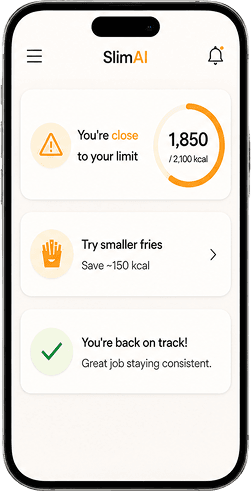
SlimAI shows your remaining protein in grams on the home screen, the AI Coach card and a home-screen widget — free — so the gap is visible while there is still a meal left to fix it.

3-day free trial · Cancel anytime · No card charged during trial
A general guideline for healthy adults. Kidney disease, liver disease, pregnancy and some medications change protein needs, sometimes substantially — ask a qualified health professional if any of those apply to you.
Protein by Goal
Same body weight, three different answers, because protein is doing a different job in each case.
1.6–2.4 g/kg
The highest of the three, which surprises people. In a calorie deficit your body will take some of the shortfall from muscle unless protein is high enough to discourage it, and protein is also the most satiating macro, so it makes the deficit easier to hold.
1.4–2.0 g/kg
Enough to support training and recovery without crowding out the carbohydrate and fat that make maintenance comfortable. Sit at the lower end if you are not training hard.
1.6–2.2 g/kg
Above this range the extra protein is mostly used for energy rather than growth, and in a surplus that space is better given to carbohydrate to fuel training. More protein is not more muscle past a point.
Why the number is per kilogram, not per person
A 55 kg person and a 95 kg person are not solving the same problem. Protein needs scale with the amount of lean tissue you carry and have to maintain, so a per-kilogram figure travels between bodies in a way that "eat 150 g a day" does not.
Body weight is a rough proxy for lean mass rather than an exact one. At higher body fat percentages the per-kilogram figure overshoots, because fat mass does not have the same protein requirement as muscle — if you are well above a healthy body fat range, calculating from a target weight or from lean mass gives a more realistic number than calculating from current weight.
Knowing the number is the easy half
SlimAI shows your remaining protein in grams on the home screen, the AI Coach card and a home-screen widget — free — so the gap is visible while there is still a meal left to close it.
3-day free trial · Cancel anytime · No card charged during trial
Spreading protein across the day
Total daily protein matters most, but distribution is not irrelevant. Muscle protein synthesis responds to a serving of roughly 25–40 grams and then plateaus, so a single very large serving does less than the same protein split across three or four meals.
The practical version: aim for a protein source at every meal rather than saving it for dinner. The per-meal figure this calculator gives you is a distribution hint, not a target to hit exactly — being 10 grams out at lunch and correcting at dinner is fine.
Protein after 65
Protein needs go up with age rather than down. Older adults get less muscle-building response from the same amount of protein — anabolic resistance — so the intake that maintained muscle at 40 will not necessarily maintain it at 70.
This calculator raises the floor to 1.2 g/kg from age 65 for that reason, rather than raising the ceiling. If you are older and training, the goal-based ranges above still apply on top.
Daily Protein by Body Weight and Goal
Grams a day, rounded. The range within each goal is deliberate — sit lower on rest days and higher on training days.
| Body weight | Losing fat | Maintaining | Gaining muscle |
|---|---|---|---|
| 50 kg (110 lb) | 80–120 g | 70–100 g | 80–110 g |
| 60 kg (132 lb) | 96–144 g | 84–120 g | 96–132 g |
| 70 kg (154 lb) | 112–168 g | 98–140 g | 112–154 g |
| 80 kg (176 lb) | 128–192 g | 112–160 g | 128–176 g |
| 90 kg (198 lb) | 144–216 g | 126–180 g | 144–198 g |
| 100 kg (220 lb) | 160–240 g | 140–200 g | 160–220 g |
Calculated at 1.6–2.4 g/kg for fat loss, 1.4–2.0 g/kg for maintenance and 1.6–2.2 g/kg for muscle gain. Adults from 65 should not sit below 1.2 g/kg regardless of goal.
How to Calculate Your Protein Target
The calculator does it in one screen, but the arithmetic fits in your head.
- 1
Take your weight in kilograms
If you work in pounds, divide by 2.2. A 172 lb adult is about 78 kg.
- 2
Multiply by the range for your goal
Losing fat: 1.6 and 2.4. Maintaining: 1.4 and 2.0. Gaining: 1.6 and 2.2. For 78 kg losing fat that gives 125 g at the bottom and 187 g at the top.
- 3
Pick where to sit in the range
Nearer the bottom on rest days and when you are new to training, nearer the top on training days and in a steep deficit.
- 4
Divide by your number of meals
Three meals from a 150 g target is 50 g each, which is a chicken breast, a large Greek yoghurt with nuts, or a lentil dish with paneer. Four meals makes each one easier.
- 5
Adjust if you are 65 or older
Do not let the figure fall below 1.2 g/kg, whatever the goal says.
The Formulas Behind This Calculator
All computed in your browser. Nothing is uploaded and nothing is stored between visits.
Daily range
minG = weight(kg) × minPerKg · maxG = weight(kg) × maxPerKgminPerKg / maxPerKg by goal: 1.6–2.4 losing fat, 1.4–2.0 maintaining, 1.6–2.2 gaining muscle.
Where to sit in the range
training day → maxG − (maxG − minG) × 0.25 · rest day → minG + (maxG − minG) × 0.25One target rather than a range to guess within, while keeping the full range visible.
Older-adult floor
age ≥ 65 → minPerKg = max(minPerKg, 1.2)Raises the floor, not the ceiling. Anabolic resistance means the same intake builds less muscle with age.
Per meal
perMealG = targetG ÷ meals · meals clamped to 2–6A distribution hint. Muscle protein synthesis responds to roughly 25–40 g per serving and then plateaus.
Sources and method
- Morton RW et al. (2018) — systematic review and meta-analysis, British Journal of Sports Medicine — Protein supplementation increases strength and lean mass gains from resistance training, with benefits plateauing at around 1.6 g/kg/day in the pooled analysis and a confidence interval extending to about 2.2 g/kg.
- Helms ER et al. (2014) — International Journal of Sport Nutrition and Exercise Metabolism — Recommends 2.3–3.1 g per kg of fat-free mass for lean athletes in a calorie deficit, which is the basis for protein being highest during fat loss rather than lowest.
- Bauer J et al. (2013) — PROT-AGE Study Group, JAMDA — Recommends at least 1.0–1.2 g/kg/day for healthy older adults and more for those who are exercising or ill, on the basis of age-related anabolic resistance.
- Institute of Medicine — Dietary Reference Intakes for protein — The adult RDA of 0.8 g/kg/day is the amount that prevents deficiency in most people, not the amount that supports training or fat loss. It is the floor, not the target.
 FAQ
FAQ
Still Wondering About SlimAI
 How much protein do I need a day?
How much protein do I need a day?Between 1.4 and 2.4 grams per kilogram of body weight for healthy adults, depending on your goal: 1.6–2.4 g/kg while losing fat, 1.4–2.0 g/kg while maintaining, and 1.6–2.2 g/kg while gaining muscle. For an 80 kg adult that is roughly 128–192 grams a day during fat loss. The 0.8 g/kg figure often quoted is the RDA, which is the amount that prevents deficiency rather than the amount that supports training.
Do I need more protein when losing weight?
Do I need more protein when losing weight?Yes, and this is the most common mistake. Protein needs are highest during fat loss, not lowest. In a calorie deficit your body will draw on muscle as well as fat unless protein intake discourages it, and protein is also the most satiating of the three macros, so a higher intake makes the deficit easier to sustain.
Can you eat too much protein?
Can you eat too much protein?For healthy adults there is little evidence of harm at the intakes on this page, but there is a point past which extra protein stops helping — beyond roughly 2.2–2.4 g/kg the surplus is largely used for energy rather than muscle, and it displaces carbohydrate and fat you could use better. If you have kidney or liver disease, protein intake is a clinical decision and this calculator is not the right input.
How much protein should I eat per meal?
How much protein should I eat per meal?Roughly 25–40 grams per serving is where muscle protein synthesis responds before plateauing, so three or four servings across the day works better than one very large one. Take your daily target, divide by the number of meals you actually eat, and use that as a guide rather than a rule — being under at one meal and over at the next is fine.
Should I use my current weight or my goal weight?
Should I use my current weight or my goal weight?Current weight for most people. If you are well above a healthy body fat range, current weight will overshoot, because fat mass does not carry the same protein requirement as muscle — in that case calculate from your target weight or from lean body mass instead. Our body fat calculator will give you a lean mass estimate to work from.
Is plant protein counted the same way?
Is plant protein counted the same way?The gram target is the same, but plant sources are generally less concentrated and some are lower in specific amino acids, particularly leucine, which drives the muscle-building response. Practically that means eating a bit more total protein and varying your sources rather than relying on one. Soy, pea protein, lentils with grains, and dairy if you eat it, all help.
Does SlimAI calculate protein for me?
Does SlimAI calculate protein for me?Yes, and free. SlimAI sets a daily protein target in grams at setup from your body type, goal and any recorded medical condition, then shows your remaining grams on the home screen, the AI Coach card and a home-screen widget as you log. Setting your own protein number instead of the calculated one is Custom Calorie & Macro Goals, part of SlimAI Pro.
Start logging smarter with AI Meal Logging.
Log any meal, any way. Get instant calories and macros. Build the habit that sticks.
Free 3-day trial, then $7.99/month or $29.99/year. Cancel anytime.
- 50K+ food items in the food database
- 10K+ downloads on iOS and Android
- 7 languages
- 4.5★ App Store · 4.8★ Google Play (as of September 3, 2026)