


 free calculatorno signup needed
Steps to Calories Calculator: What Your Walking Burns
Enter your steps, height and weight. You get the calories burned, the distance covered and roughly how long it took — or flip it and find how many steps a calorie target takes.
Short answer
Roughly 200 to 450 calories for most adults, depending mainly on body weight and stride length. A 175 cm (5 ft 9 in), 80 kg (176 lb) adult covers about 7.3 km (4.5 miles) in 10,000 steps and burns about 330 calories from the walking itself. A 163 cm (5 ft 4 in), 68 kg (150 lb) adult burns about 260.
A step count is a measure of distance more than effort. Calories come from moving your body weight over that distance, so the same number on a pedometer means something different for every person wearing it.
This calculator uses the formula SlimAI applies when it syncs steps from Apple Health or Health Connect: stride from height, distance from steps, calories from weight and distance.

3-day free trial · Cancel anytime · No card charged during trial
Steps to Calories Calculator
How many calories your steps burn at your height and weight, or how many steps it takes to burn a number you have in mind.
| Steps | Distance | Calories |
|---|---|---|
| 5,000 | 3.63 km | 161 kcal |
| 7,500 | 5.45 km | 242 kcal |
| 10,000 | 7.26 km | 323 kcal |
| 12,500 | 9.08 km | 404 kcal |
| 15,000 | 10.89 km | 484 kcal |
| 20,000 | 14.52 km | 646 kcal |
Calories from walking, not your whole day
SlimAI runs this exact formula on your real steps.
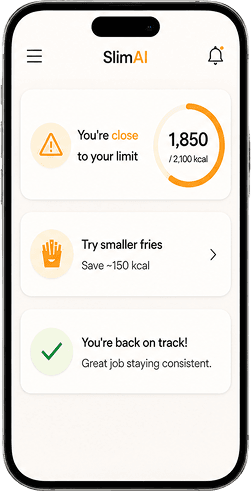
Connect Apple Health or Health Connect and SlimAI turns each day's steps into burned calories the same way, next to the food you logged. You choose whether burned calories are added back to your daily target.

3-day free trial · Cancel anytime · No card charged during trial
An estimate for level walking at a normal to brisk pace. Hills, a heavy pack, running and individual efficiency all change the figure, and step counters themselves miss or add steps. Not medical advice.
Steps by Goal
Walking is the easiest activity to add and the easiest to overcount. What it is worth depends on what you want it to do.
A few hundred calories, every day
An extra 5,000 steps is roughly 150 calories for a 75 kg adult. Small per day, but it adds up across a week without making you hungrier the way hard training can.
6,000 to 10,000 steps
A 2022 meta-analysis found mortality risk kept falling with more daily steps up to about 6,000–8,000 for adults over 60 and 8,000–10,000 for younger adults.
Count them into your surplus
On a bulk, a high step count can quietly erase your surplus. If the scale is not moving, check your steps before you add more food.
Why your height and weight change the answer
Stride length scales with height — about 41% of it for a typical walking step — so a 190 cm person covers roughly 2,000 steps per mile while a 160 cm person needs over 2,400. More distance per step means more calories per step.
Weight matters even more. Walking costs energy in proportion to the mass you are moving, so 10,000 steps burn about 240 calories for a 60 kg adult at 170 cm and over 420 for a 105 kg adult of the same height.
Steps and food in the same place
SlimAI reads your steps from Apple Health or Health Connect, turns them into burned calories with this same formula, and shows them next to what you ate. Adding them back to your target is your choice.
3-day free trial · Cancel anytime · No card charged during trial
Do not count your steps twice
These figures are the energy the walking itself costs — roughly what you burn above sitting still. They are not a total for the day.
If you worked out your maintenance calories with an activity level such as "lightly active", your usual walking is already inside that number. Only steps beyond your normal routine are extra. Counting all of them again on top is one of the most common reasons a calorie deficit stops working on paper but not on the scale.
Is 10,000 steps the right target?
The number became popular through marketing rather than research, but research has since caught up with it. A meta-analysis of 15 cohorts and about 47,000 adults found mortality risk fell as daily steps rose, levelling off at about 6,000–8,000 steps for adults aged 60 and over and 8,000–10,000 for younger adults.
For weight, the best step target is the one above your current average that you can keep. Going from 4,000 to 7,000 steps a day is worth more than reaching 10,000 for one week.
Calories Burned by Steps and Body Weight
Calories from the walking itself for an adult 170 cm (5 ft 7 in) tall. Taller people burn slightly more per step, shorter people slightly less.
| Steps | Distance | 60 kg (132 lb) | 75 kg (165 lb) | 90 kg (198 lb) | 105 kg (231 lb) |
|---|---|---|---|---|---|
| 2,500 | 1.8 km (1.1 mi) | 60 | 75 | 90 | 106 |
| 5,000 | 3.5 km (2.2 mi) | 121 | 151 | 181 | 211 |
| 7,500 | 5.3 km (3.3 mi) | 181 | 226 | 271 | 317 |
| 10,000 | 7.1 km (4.4 mi) | 241 | 302 | 362 | 422 |
| 12,500 | 8.8 km (5.5 mi) | 302 | 377 | 452 | 528 |
| 15,000 | 10.6 km (6.6 mi) | 362 | 452 | 543 | 633 |
Level walking at a normal to brisk pace. Hills, a heavy bag or running all raise the figure.
How to Calculate Calories From Steps
Three steps, and the first one only needs doing once.
- 1
Estimate your stride
Multiply your height by 0.415. At 175 cm that is a stride of about 0.73 m, or 29 inches.
- 2
Turn steps into distance
Steps × stride. 10,000 steps × 0.73 m is 7,300 m, or 7.3 km (4.5 miles).
- 3
Multiply by your weight and 0.57
80 kg × 7.3 km × 0.57 ≈ 330 calories. In pounds and miles, that is about 0.42 calories per pound per mile.
- 4
Only count what is extra
If your maintenance calories already include an active day, add only the steps beyond your usual routine.
The Formula Behind This Calculator
The same three lines SlimAI runs on synced steps, computed in your browser. Nothing is uploaded or stored.
Stride length
stride (m) = height (cm) ÷ 100 × 0.415A common pedometer estimate: a walking step is about 41% of height.
Distance
distance (km) = steps × stride ÷ 1000Miles = km ÷ 1.609.
Calories
kcal = weight (kg) × distance (km) × 0.57Slightly above the net cost of level walking in the ACSM walking equation (about 0.5 kcal per kg per km), and below the gross cost once resting burn is added.
Steps to burn a target
steps = kcal ÷ (weight × 0.57) × 1000 ÷ strideThe same formula run backwards.
Sources and method
- American College of Sports Medicine — metabolic equations for walking — The ACSM walking equation puts the oxygen cost of level walking at 0.1 ml per kg of body weight per metre on top of resting oxygen use, which works out at about 0.5 kcal per kg per km above rest.
- Aguiar EJ et al. (2019) — Journal of Physical Activity and Health — A walking cadence of 100 steps a minute or more corresponded to at least moderate intensity (3 METs) for 80% of adults who reached it during overground walking.
- Paluch AE et al. (2022) — The Lancet Public Health — Meta-analysis of 15 cohorts and 47,471 adults. Mortality risk fell with more daily steps until about 6,000–8,000 steps for adults aged 60 and over and 8,000–10,000 for adults under 60.
 FAQ

Still Wondering About SlimAI
 How many calories does walking 10,000 steps burn?

How many calories does walking 10,000 steps burn?Roughly 200 to 450 calories for most adults. At 175 cm and 80 kg it is about 330 calories over 7.3 km (4.5 miles). Heavier and taller people burn more for the same steps, lighter and shorter people burn less.
How many steps does it take to burn 500 calories?
How many steps does it take to burn 500 calories?About 15,000 steps for a 175 cm, 80 kg adult, which is roughly 11 km or 6.8 miles. A lighter person needs more steps for the same 500 calories, a heavier person fewer. Enter your own height and weight above for your number.
How many calories does walking a mile burn?
How many calories does walking a mile burn?About 0.9 calories per kilogram of body weight per mile, on top of what you burn at rest — roughly 55 calories for a 60 kg (132 lb) adult, 65 for 70 kg (154 lb) and 90 for 100 kg (220 lb). Speed matters less than distance at normal walking paces.
How many steps are in a mile?
How many steps are in a mile?About 2,000 to 2,400 for most adults walking, depending on height. A 160 cm (5 ft 3 in) adult takes roughly 2,400 steps per mile, a 175 cm (5 ft 9 in) adult about 2,200, and a 190 cm (6 ft 3 in) adult about 2,000.
Does walking faster burn more calories?
Does walking faster burn more calories?More per minute, but not much more per step at normal speeds, because the cost of walking is mostly set by distance and body weight. Very fast walking and hills do cost more per kilometre. If time is your limit, walk faster; if not, walk further.
Should I eat back the calories from my steps?
Should I eat back the calories from my steps?Only the steps beyond your usual routine, and only if your maintenance figure did not already assume them. Step-based calories are estimates, so many people eat back half and watch the scale for two weeks before deciding.
How accurate are calories from steps?
How accurate are calories from steps?Reasonable for level walking, less so for hills, stairs or running. Step counters also miss or add steps, and stride length varies by person. Treat the figure as a good estimate for comparing days rather than an exact measurement.
Does SlimAI count my steps?
Does SlimAI count my steps?Yes. SlimAI reads steps from Apple Health on iPhone and Health Connect on Android, converts them to burned calories with the formula on this page, and shows them next to the food you logged. You decide whether burned calories are added back to your daily goal.
Start logging smarter with AI Meal Logging.
Log any meal, any way. Get instant calories and macros. Build the habit that sticks.
Free 3-day trial, then $7.99/month or $29.99/year. Cancel anytime.
- 50K+ food items in the food database
- 10K+ downloads on iOS and Android
- 7 languages
- 4.5★ App Store · 4.8★ Google Play (as of September 3, 2026)