


 free calculatorno signup needed
Free Water Intake Calculator
Work out how much fluid your body weight, age, training, and climate point to for a day — and how much of that should come from drinks rather than food.
Short answer
A common working guideline for healthy adults is 30–40 ml of total water per kilogram of body weight per day, which is about 2.3–3.1 litres for a 78 kg adult. Roughly 20% of that arrives through food, so the amount to actually drink is closer to 1.9–2.5 litres. Add about 350 ml for every 30 minutes of exercise, and more again in hot or humid conditions.
There is no single correct number, and anyone who gives you one without asking your weight, your training, or your climate is guessing. Fluid needs scale with body size, activity, temperature, and what you eat.
The "eight glasses a day" rule has no clear scientific origin, and it happens to be roughly right for a small, sedentary adult in a mild climate — and meaningfully wrong for a 95 kg person training in summer heat.

3-day free trial · Cancel anytime · No card charged during trial
Water Intake Calculator
How much fluid a day your body weight, age, training, and climate point to — and how much of it should come from drinks.
Minutes of training that make you sweat.
Drink this much
2.92 litres
That is about 12 glasses (250 ml) or 5.8 bottles (500 ml) across the day.
How this number was built
- Baseline from body weight and age: 3120 ml (40 ml per kg)
- Exercise: +525 ml for 45 minutes
- Climate (temperate): +0 ml
Knowing the number is easy. Hitting it every day is not.
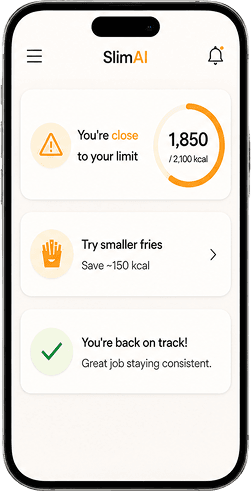
Sign up and SlimAI stores this target, logs water by jug, bottle, mug, or glass, and sends reminders when the day is running dry.

3-day free trial · Cancel anytime · No card charged during trial
A general guideline for healthy adults, not medical advice. Kidney, heart, and liver conditions, some medications, and pregnancy change fluid needs — ask a qualified health professional if any of those apply to you.
What Hydration Actually Does for Your Goal
Water is not a fat-loss tool and does not burn calories on its own. What it does is make everything else you are doing work properly — appetite signals, training quality, digestion, and the reliability of the number on the scale.
Fullness, fewer liquid calories, and a scale you can trust
Drinking water before meals has been shown in trials to modestly reduce intake at that meal, and replacing sugary drinks with water removes calories without touching your food. Hydration also stabilises weigh-ins: dehydration and heavy salt intake move scale weight by a kilogram or more in either direction, which is enough to make a good week look like a bad one.
Training quality and recovery between sessions
Building muscle depends on the quality of your sessions, and losing as little as 2% of body mass in fluid measurably reduces strength endurance and increases perceived effort. Muscle tissue is roughly 70–75% water. If you are eating in a surplus and training hard, under-drinking quietly caps what that work returns.
The habit that costs nothing and holds everything together
Consistent hydration supports digestion, joint lubrication, temperature regulation, and cognitive performance — mild dehydration is associated with reduced concentration and worse mood. It is the cheapest habit in any plan, and the easiest one to keep once it is being tracked instead of remembered.
Where the Numbers Come From
Two approaches dominate, and they broadly agree. The Institute of Medicine set adequate total water intake at about 3.7 litres a day for men and 2.7 litres for women aged 19 and over — and, importantly, that is total water from all sources, including food.
The body-weight approach used by this calculator scales instead of averaging: roughly 30–40 ml per kilogram per day, adjusted down with age because total body water declines and kidney concentrating ability changes. For a 78 kg adult at 35 ml/kg that is about 2.7 litres of total water.
Both then need the same correction. Food contributes roughly 20% of total water intake for a typical mixed diet — more if you eat a lot of fruit, vegetables, soup, and yoghurt, less on a very dry diet. So a 2.7 litre total need means drinking around 2.2 litres, not 2.7.
Tea, coffee, milk, and juice all count toward that. The idea that caffeinated drinks dehydrate you does not hold at ordinary intakes: the mild diuretic effect is more than offset by the fluid volume of the drink itself. Alcohol is the genuine exception — it suppresses vasopressin and increases fluid loss.
Institute of Medicine adequate intake
About 3.7 L a day for men and 2.7 L for women, total water from drinks and food combined.
Body-weight scaling
Roughly 30–40 ml per kg per day, which adapts to body size instead of assuming an average adult.
Food contributes about 20%
Fruit, vegetables, soups, yoghurt, and even bread and rice carry water. Drinks do not have to cover the whole total.
Coffee and tea count
At normal intakes their fluid volume outweighs the mild diuretic effect. Alcohol is the real exception.
The target is easy. The 6pm realisation that you have had one glass is the problem.
SlimAI logs water by jug, bottle, mug, or glass, tracks it against your daily goal, and reminds you when the day is running dry.
3-day free trial · Cancel anytime · No card charged during trial
What Changes Your Needs
The baseline is only a baseline. Four things move it enough to matter.
Exercise is the largest single factor. Sweat rates vary from roughly 0.5 to 2 litres an hour depending on intensity, heat, humidity, clothing, and how well acclimatised you are. This calculator adds about 350 ml per 30 minutes of sweating exercise, which is a middle-of-the-road assumption — heavy sweaters in hot conditions need substantially more, and for sessions over about 90 minutes, sodium replacement starts to matter alongside the fluid itself.
Heat and humidity raise needs even without training, because sweating continues at rest. Altitude increases fluid loss through faster breathing and increased urine output. Illness with fever, vomiting, or diarrhoea sharply increases losses and is the situation where dehydration escalates fastest.
Pregnancy and breastfeeding both raise requirements — modestly during pregnancy, and substantially while breastfeeding, since milk production itself consumes water. Some medications, particularly diuretics, change fluid balance meaningfully. If any of those apply, the number to work from is the one a health professional gives you, not this page.
Checking Hydration Without a Calculator
The most practical daily check costs nothing: urine colour. Pale straw suggests adequate hydration; dark yellow or amber suggests you are behind. First-morning urine is naturally darker and is not a fair test, and B-vitamin supplements turn urine bright yellow regardless of hydration.
Thirst is a real signal but a lagging one — it typically registers after fluid loss has already begun affecting performance, and it becomes less reliable with age. Relying on thirst alone tends to leave active people mildly under-hydrated through the day.
Over-drinking is also possible and, rarely, dangerous. Consuming very large volumes of plain water in a short window can dilute blood sodium — hyponatraemia — which is a genuine medical emergency and has occurred in endurance events and drinking challenges. Healthy kidneys handle about 0.8 to 1.0 litres per hour, so spreading intake through the day is both easier and safer than drinking in bulk.
Pale straw is the target
Check colour through the day rather than first thing in the morning, when urine is naturally concentrated.
Thirst lags behind need
By the time you feel it, performance is often already affected. Active people benefit from drinking on a schedule.
Spread it out
Roughly a glass an hour through the waking day beats two litres in one sitting, which mostly ends up in the bathroom.
Long or hot sessions need sodium too
Beyond about 90 minutes of heavy sweating, replacing electrolytes matters alongside the water.
Why a Target Only Works If Something Counts It
Hydration is the most forgettable habit in any plan, because nothing reminds you. Meals announce themselves; water does not. The usual failure mode is realising at six in the evening that you have had one glass and a coffee.
SlimAI Calorie Tracker handles water the way it handles food — as something logged rather than remembered. Water is logged by utensil (jug, bottle, mug, or glass) with custom quantities, so a swig from a 750 ml gym bottle is one tap rather than a mental conversion. A daily goal sits behind it, and the app suggests an intake target based on your profile.
Reminders are server-scheduled, so water prompts arrive even when the app has not been opened, alongside meal-logging, fasting-window, and streak notifications. A single profile setting turns them on or off.
And because it is stored, it becomes data rather than a feeling. Water intake sits next to calories, macros, steps, workouts, and weight in the same statistics view — which is how you find out that the weeks you hit your water goal are also the weeks you trained best.
Daily Water Intake by Body Weight
Total water need from drinks and food combined, then the amount to actually drink after subtracting the roughly 20% that comes from food. Based on 35 ml per kilogram, before adding exercise or heat.
| Body weight | Total water need | From drinks (≈80%) | In 500 ml bottles |
|---|---|---|---|
| 50 kg (110 lb) | 1.75 L / 59 fl oz | 1.4 L / 47 fl oz | About 2.8 bottles |
| 60 kg (132 lb) | 2.10 L / 71 fl oz | 1.7 L / 57 fl oz | About 3.4 bottles |
| 70 kg (154 lb) | 2.45 L / 83 fl oz | 2.0 L / 66 fl oz | About 3.9 bottles |
| 80 kg (176 lb) | 2.80 L / 95 fl oz | 2.2 L / 76 fl oz | About 4.5 bottles |
| 90 kg (198 lb) | 3.15 L / 107 fl oz | 2.5 L / 85 fl oz | About 5.0 bottles |
| 100 kg (220 lb) | 3.50 L / 118 fl oz | 2.8 L / 95 fl oz | About 5.6 bottles |
Add roughly 350 ml per 30 minutes of sweating exercise, 350–700 ml for warm or hot and humid conditions, and more again during pregnancy or breastfeeding. Adults over 55 typically need slightly less per kilogram than the 35 ml used here.
How to Calculate Your Daily Water Intake
The calculator above does this in one screen, but the arithmetic is simple enough to do in your head once you know the steps.
- 1
Start from your body weight
Multiply your weight in kilograms by 35 ml. A 78 kg adult starts at 78 × 35 = 2,730 ml, or about 2.7 litres of total water a day.
- 2
Adjust for age
Use about 40 ml/kg if you are under 30, 35 ml/kg from 31 to 55, 30 ml/kg from 56 to 65, and 25 ml/kg above 65. Total body water declines with age, and so does the amount needed per kilogram.
- 3
Add for exercise
Add roughly 350 ml for every 30 minutes of exercise that makes you sweat. A one-hour session adds about 700 ml — more in heat, more if you sweat heavily.
- 4
Add for heat and humidity
Warm conditions add around 350 ml; genuinely hot or humid conditions around 700 ml, even without training, because sweating continues at rest.
- 5
Subtract what comes from food
Roughly 20% of your total water intake arrives through food. Multiply the total by 0.8 to get the amount to actually drink — for that 78 kg adult with an hour of training, about 2.7 litres from drinks.
- 6
Spread it across the day and check the colour
Aim for roughly a glass an hour while awake rather than large volumes at once, and use pale straw urine as your day-to-day confirmation that the number is about right.
The Formulas Behind This Calculator
All computed in your browser. Nothing is uploaded and nothing is stored between visits.
Baseline from body weight and age
baseline(ml) = weight(kg) × mlPerKg · mlPerKg = 40 (≤30) / 35 (31–55) / 30 (56–65) / 25 (66+)Total water need before exercise, climate, or pregnancy adjustments.
Exercise addition
exercise(ml) = (minutes / 30) × 350A mid-range assumption. Heavy sweaters in hot conditions can lose two or three times this.
Climate and life-stage additions
warm +350 ml · hot/humid +700 ml · pregnant +300 ml · breastfeeding +700 mlAdded on top of the baseline and exercise figures.
What to actually drink
fromDrinks(ml) = total × 0.8The remaining 20% is the water that arrives through food in a typical mixed diet.
Sources and method
- Institute of Medicine (2004) — Dietary Reference Intakes for Water — Adequate total water intake of approximately 3.7 L a day for men and 2.7 L for women aged 19+, from drinks and food combined, and the estimate that food supplies about 20% of total intake.
- European Food Safety Authority — dietary reference values for water — Adequate intakes of 2.5 L a day for men and 2.0 L for women under moderate temperature and activity conditions.
- American College of Sports Medicine — exercise and fluid replacement — Sweat-rate variability and the performance effects of fluid deficits above roughly 2% of body mass, which inform the per-session addition used here.
- Killer SC, et al. (2014) — No evidence of dehydration from moderate coffee consumption in habitual drinkers — the basis for counting tea and coffee toward daily fluid intake.
 FAQ
FAQ
Still Wondering About SlimAI
 How much water should I drink a day?
How much water should I drink a day?A practical guideline for healthy adults is 30–40 ml of total water per kilogram of body weight, which is about 2.7 litres for a 78 kg adult. Roughly 20% of that comes from food, so the amount to drink is closer to 2.2 litres. Add about 350 ml per 30 minutes of sweating exercise and 350–700 ml in warm or hot conditions.
Is eight glasses of water a day correct?
Is eight glasses of water a day correct?It is a rough approximation with no clear scientific origin. Eight 250 ml glasses is 2 litres, which happens to suit a smaller, sedentary adult in a mild climate and understates the needs of a heavier or more active person in the heat. Scaling to body weight and activity gives a far more useful number.
Do tea, coffee, and other drinks count toward my water intake?
Do tea, coffee, and other drinks count toward my water intake?Yes. Tea, coffee, milk, juice, and soft drinks all contribute fluid, and at ordinary intakes the mild diuretic effect of caffeine is outweighed by the volume of the drink. Alcohol is the exception — it increases fluid loss. Food also contributes roughly 20% of total water intake.
Does drinking water help you lose weight?
Does drinking water help you lose weight?Indirectly. Water contains no calories, and replacing sugary drinks with it removes calories without changing your food. Trials have also found that drinking water before a meal modestly reduces intake at that meal. Water does not burn fat by itself — the benefit comes from appetite, from displacing liquid calories, and from more reliable weigh-ins.
How do I know if I am drinking enough?
How do I know if I am drinking enough?Urine colour is the most practical check: pale straw suggests adequate hydration, dark yellow or amber suggests you are behind. First-morning urine is naturally darker, and B-vitamin supplements turn it bright yellow regardless. Thirst is a real signal but lags behind actual need, especially with age.
Can you drink too much water?
Can you drink too much water?Yes, though it is uncommon. Consuming very large volumes of plain water in a short period can dilute blood sodium — hyponatraemia — which is a medical emergency and has occurred in endurance events and drinking challenges. Healthy kidneys handle roughly 0.8 to 1.0 litres per hour, so spreading intake through the day is both easier and safer.
How much more water do I need when I exercise?
How much more water do I need when I exercise?About 350 ml per 30 minutes of exercise is a reasonable planning figure, but sweat rates range from roughly 0.5 to 2 litres an hour depending on intensity, heat, humidity, and acclimatisation. For sessions beyond about 90 minutes of heavy sweating, replacing sodium matters alongside the fluid.
Does SlimAI track water intake?
Does SlimAI track water intake?Yes. SlimAI Calorie Tracker logs water by utensil — jug, bottle, mug, or glass — with custom quantities, tracks it against a daily goal, and suggests an intake target from your profile. Server-scheduled reminders arrive even when the app has not been opened, and water sits alongside calories, macros, steps, and weight in the same statistics view.
Start logging smarter with AI Meal Logging.
Log any meal, any way. Get instant calories and macros. Build the habit that sticks.
Free 3-day trial, then $7.99/month or $29.99/year. Cancel anytime.
- 50K+ food items in the food database
- 10K+ downloads on iOS and Android
- 7 languages
- 4.5★ App Store · 4.8★ Google Play (as of September 3, 2026)