


 free calculatorno signup needed
Keto Calculator: Your Keto Macros in Grams
Set a carbohydrate limit and a protein level, and the calculator fills the rest of your calories with fat. A net carbs calculator for food labels sits underneath.
Short answer
Set carbohydrate as a ceiling — usually 20–50 grams a day — set protein from your body weight, typically 1.2–2.0 g per kg, and let fat fill the rest of your calories. For an 80 kg (176 lb) adult eating 1,900 calories with 20 g of carbs and 1.6 g/kg of protein, that is 128 g of protein, 20 g of carbs and about 145 g of fat — roughly 27% / 4% / 69%.
Most keto calculators start with a percentage split like 70/25/5 and work backwards. That gets the one number that matters wrong: carbohydrate on keto is a gram ceiling, and 5% of 2,500 calories is a different number from 5% of 1,500.
This calculator starts from the ceiling, sets protein from your weight, and treats fat as what is left — which is how keto is actually eaten.

3-day free trial · Cancel anytime · No card charged during trial
Keto Calculator
Daily keto macros in grams: a carbohydrate ceiling, protein from your body weight, and fat for the rest of your calories.
About 0.5 kg (1.1 lb) a week — the pace most people can hold without wrecking training or mood.
The strict end. Most induction-phase plans start here.
Where the calories came from
Net carbs on a label
5 g net carbs — 12 g total minus 7 g of fibre and sugar alcohols. Maltitol is partly absorbed, so many people subtract only half of it.
20 g of carbohydrate goes fast. Count it before you eat it.
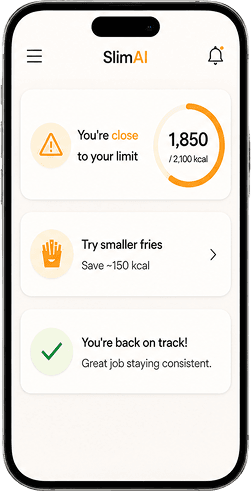
SlimAI logs a meal from a photo and shows its carbohydrate in grams, and keto is one of the diet preferences you can set in your profile. Setting your own gram-level carb target is part of SlimAI Pro.

3-day free trial · Cancel anytime · No card charged during trial
Ketogenic diets are not suitable for everyone. If you have diabetes and take insulin or other glucose-lowering medication, kidney or liver disease, a history of pancreatitis or disordered eating, or are pregnant or breastfeeding, speak to a qualified health professional first. Not medical advice.
Choosing Your Carb Limit
All three are ketogenic for most people. Lower is stricter, not better; pick the limit you can keep.
20 g a day
The usual starting point. Mostly leafy and non-starchy vegetables, with almost no room for fruit, grains or sugar.
30 g a day
A common everyday ceiling once the first weeks are over. Room for more vegetables, berries and nuts.
50 g a day
The usual upper bound of a ketogenic diet. Above this most people are low-carb rather than in ketosis.
Why keto macros start with grams, not percentages
A 70/25/5 split sounds precise until your calories change. At 2,400 calories 5% is 30 g of carbohydrate; at 1,500 it is 19 g. The ceiling that keeps you in ketosis did not move, so the percentage was never the real target.
Protein works the same way. It should follow your body weight and training, not shrink because fat takes a larger share. Set carbs and protein in grams, and fat becomes the dial you turn for weight loss or maintenance.
Twenty grams goes faster than you think
SlimAI logs a meal from a photo and shows its carbohydrate in grams, so the sauce, the fruit and the "just one" are visible before you are over. Setting your own gram-level carb target is part of SlimAI Pro.
3-day free trial · Cancel anytime · No card charged during trial
Keto is not a faster way to lose fat
A 2019 scientific statement from the National Lipid Association reviewed the evidence and concluded that low-carb and very-low-carb diets are not superior to other approaches for weight loss. They may help with appetite control and triglycerides, and they cut medication use in some people with type 2 diabetes.
The quick drop on the scale in the first week is mostly water released with stored glycogen. Fat loss after that follows the same calorie arithmetic as any other diet, which is why this calculator starts from your calorie target.
Net carbs, fibre and sugar alcohols
Net carbs are total carbohydrate minus fibre and sugar alcohols, on the reasoning that neither is fully digested. It is a widely used convention, but not a term the FDA defines, so labels and apps do not always agree.
Sugar alcohols are not equal. Erythritol has almost no effect on blood sugar, while maltitol is partly absorbed, so many people subtract only half of it. If a "low net carb" product stalls your progress, count it in total carbs instead.
Keto Macros by Calorie Target
An 80 kg (176 lb) adult with a 20 g carb limit and protein at 1.6 g per kg. Protein and carbs stay fixed; fat is what changes.
| Daily calories | Protein | Carbs | Fat | Split (P / C / F) |
|---|---|---|---|---|
| 1,500 | 128 g | 20 g | 101 g | 34% / 5% / 61% |
| 1,800 | 128 g | 20 g | 134 g | 28% / 4% / 67% |
| 2,100 | 128 g | 20 g | 168 g | 24% / 4% / 72% |
| 2,400 | 128 g | 20 g | 201 g | 21% / 3% / 75% |
Notice the percentages move while the grams that matter stay put — the reason this calculator works in grams.
How to Calculate Keto Macros
Four steps, and only the last one involves fat.
- 1
Find your calorie target
Maintenance calories minus a deficit if you want to lose weight. The calculator above uses Mifflin-St Jeor and your activity level.
- 2
Set the carb ceiling
20 g to start, 30 g once you are settled, 50 g as an upper limit. That is 80–200 calories.
- 3
Set protein from body weight
1.2 g per kg if you are not training, 1.6 if you are, 2.0 if you are lifting hard in a deficit. At 80 kg and 1.6 that is 128 g, or 512 calories.
- 4
Fill the rest with fat
(calories − protein calories − carb calories) ÷ 9. At 1,900 calories: (1,900 − 512 − 80) ÷ 9 ≈ 145 g.
The Formulas Behind This Calculator
Computed in your browser. Nothing is uploaded and nothing is stored between visits.
Calorie target
target = max(BMR × activity + goal adjustment, floor)Mifflin-St Jeor, with the same goal presets as the TDEE calculator. For a loss goal the target never drops below 1,200 kcal (women) or 1,500 kcal (men).
Protein
protein (g) = weight (kg) × 1.2, 1.6 or 2.0Set from body weight, independent of the fat share.
Fat
fat (g) = (target − protein × 4 − carbs × 4) ÷ 9If protein and carbs use up every calorie, the calculator says so instead of returning negative fat.
Net carbs
net = total carbs − fibre − sugar alcoholsA convention, not an FDA definition. Some people subtract only half of maltitol.
Sources and method
- Kirkpatrick CF et al. (2019) — National Lipid Association scientific statement, Journal of Clinical Lipidology — Reviewed systematic reviews and meta-analyses of low-carbohydrate and very-low-carbohydrate diets and concluded they are not superior to other dietary approaches for weight loss, with possible advantages for appetite control, triglycerides and medication use in type 2 diabetes.
- Mifflin MD et al. (1990) — American Journal of Clinical Nutrition — The resting energy equation used for the calorie target.
 FAQ

Still Wondering About SlimAI
 How many carbs can I eat on keto?

How many carbs can I eat on keto?Usually 20–50 grams of carbohydrate a day. Most people start at 20 g and some move up to 30–50 g once they are settled. The exact level that keeps you in ketosis varies from person to person.
How much protein should I eat on keto?
How much protein should I eat on keto?About 1.2–2.0 g per kg of body weight. Use the lower end if you are not training and the higher end if you lift, especially in a calorie deficit. At 80 kg that is 96–160 g a day.
How much fat should I eat on keto?
How much fat should I eat on keto?Whatever is left after protein and carbohydrate, up to your calorie target. Fat is not a minimum to hit: if you are trying to lose weight, eating less fat than the calculator shows is how the deficit happens.
What are net carbs?
What are net carbs?Total carbohydrate minus fibre and sugar alcohols. A food with 12 g of carbs and 7 g of fibre has 5 g of net carbs. It is a common convention rather than an FDA-defined term, and maltitol is partly absorbed, so some people subtract only half of it.
Is keto better for weight loss than other diets?
Is keto better for weight loss than other diets?Not according to a 2019 National Lipid Association review, which found low-carb and very-low-carb diets were not superior for weight loss. Some people find keto easier because it reduces appetite. The first week’s drop is mostly water.
What percentage should my keto macros be?
What percentage should my keto macros be?Commonly around 70–75% fat, 20–25% protein and 5% carbohydrate, but the percentages follow from the grams rather than the other way round. Set carbs and protein in grams; the percentages then depend on your calories.
Does SlimAI work for keto?
Does SlimAI work for keto?You can set keto as your diet preference in your SlimAI profile, and every meal you log shows its carbohydrate in grams. SlimAI’s calculated macro split is based on your body type rather than keto, so to follow a 20 g carb target exactly you would set your own gram-level targets, which is part of SlimAI Pro.
Start logging smarter with AI Meal Logging.
Log any meal, any way. Get instant calories and macros. Build the habit that sticks.
Free 3-day trial, then $7.99/month or $29.99/year. Cancel anytime.
- 50K+ food items in the food database
- 10K+ downloads on iOS and Android
- 7 languages
- 4.5★ App Store · 4.8★ Google Play (as of September 3, 2026)