


 free calculatorno signup needed
Intermittent Fasting Calculator: When Your Fast Ends
Choose a plan and enter your last meal. You get the time your fast ends, the hours your eating window is open, and a 24-hour picture of the day.
Short answer
Add your plan's fasting hours to the time of your last meal. On 16:8, a last meal at 8:00 PM means the fast ends at 12:00 PM the next day, and you eat between 12:00 PM and 8:00 PM. The same 8:00 PM finish ends a 14:10 fast at 10:00 AM and a 20:4 fast at 4:00 PM.
Time-restricted eating is simple arithmetic dressed up in ratios. 16:8 means sixteen hours without calories and an eight-hour window to eat in; the only real decision is where those eight hours sit in your day.
This calculator handles the arithmetic for the five common daily plans and the two weekly ones, and shows the result on a 24-hour bar so you can see whether the window lands somewhere you can actually live with.

3-day free trial · Cancel anytime · No card charged during trial
Intermittent Fasting Calculator
Pick a plan and the time of your last meal to see when your fast ends and when your eating window closes.
16:8: most popular
Stop eating at 8:00 PM, eat again at 12:00 PM.
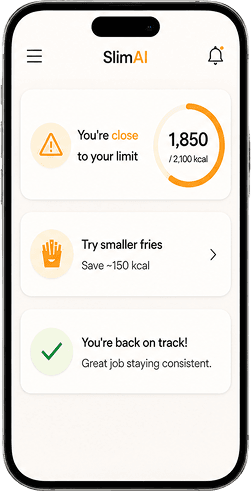
SlimAI's fasting tracker runs 14:10, 16:8, 20:4, OMAD, 6:1 and 5:2 plans with a live countdown, and the meals you eat inside the window count against your daily calorie target in the same app.

3-day free trial · Cancel anytime · No card charged during trial
Fasting is not suitable for everyone. If you are pregnant or breastfeeding, under 18, have diabetes or take medication that affects blood sugar, or have a history of disordered eating, speak to a qualified health professional before starting. Not medical advice.
Which Plan Fits
The best plan is the one whose window you will still be keeping in a month. Start shorter than you think you need.
14:10 or 16:8
Most of the fast is overnight. 14:10 usually means a later breakfast; 16:8 usually means skipping it. Either fits three meals or two meals and a snack.
18:6 or 20:4
Shorter windows suit people who already find 16:8 easy. Two meals fit a six-hour window; four hours usually means one large meal and one small one.
5:2 or 6:1
No daily window at all. You eat normally most days and keep one or two non-consecutive days to about 500 calories. Some people find two hard days easier than seven disciplined ones.
Fasting does not burn more fat than the same calories eaten later
The largest trials so far point the same way. In a 12-week randomised trial of 16:8, people who ate between noon and 8 PM lost no more weight than people who ate three meals across the day. A 12-month trial in the New England Journal of Medicine compared calorie restriction with and without an eight-hour eating window and found no meaningful difference either.
So the window is a structure, not a mechanism. It works when it makes eating less easier — fewer evening snacks, one meal you no longer have to plan — and it does nothing if the same food simply moves into fewer hours. That is why calories still matter on a fasting plan.
A window you can see beats one you have to remember
SlimAI's fasting tracker counts down your fast live and keeps the meals you eat inside the window against your daily calorie target, in one app.
3-day free trial · Cancel anytime · No card charged during trial
Where to put your eating window
Pick the window around the meal you least want to give up. If family dinner is fixed, finish at 8 PM and start at noon. If breakfast matters more, an early window such as 8 AM to 4 PM works on the same 16:8 plan.
Training is the other anchor. Lifting late in a fast is fine for most people, but if sessions feel flat, move the window so a meal lands within a few hours before or after training.
Protein inside a short window
The shorter the window, the harder protein becomes. Fitting 130 g of protein into two meals means 65 g per meal, which is a lot of chicken or Greek yoghurt in one sitting.
On 20:4 and OMAD, plan protein first and build the rest of the meal around it. If you are training and losing weight on a short window, check the number with the protein calculator before you start.
Fasting Schedules From an 8:00 PM Last Meal
Every plan, starting from the same last meal. Move the last meal and every time shifts by the same amount.
| Plan | Fast ends | Eating window | Fasting hours a week |
|---|---|---|---|
| 14:10 | 10:00 AM | 10:00 AM – 8:00 PM | 98 hours |
| 16:8 | 12:00 PM | 12:00 PM – 8:00 PM | 112 hours |
| 18:6 | 2:00 PM | 2:00 PM – 8:00 PM | 126 hours |
| 20:4 | 4:00 PM | 4:00 PM – 8:00 PM | 140 hours |
| 22:2 (OMAD) | 6:00 PM | 6:00 PM – 8:00 PM | 154 hours |
5:2 and 6:1 have no daily window: two or one non-consecutive days a week at about 500 calories, normal eating otherwise.
How to Work Out Your Fasting Window
The calculator does it instantly, but it is one addition.
- 1
Choose a plan
The first number is hours fasting, the second is hours eating. They always add to 24.
- 2
Note when you finish eating
The fast starts with your last bite, not when you go to bed.
- 3
Add the fasting hours
8:00 PM plus 16 hours is 12:00 PM the next day. That is your first meal.
- 4
Your window closes at the same clock time you stopped
On a daily plan the window ends at the time your fast began, ready for the next one.
- 5
Ease into longer fasts
Moving from 14:10 to 16:8 to 18:6 an hour or two at a time is easier than starting on 20:4.
The Arithmetic Behind This Calculator
Everything runs in your browser. Nothing is uploaded and nothing is stored between visits.
When the fast ends
fastEnd = lastMeal + fastingHoursWraps past midnight, so a fast that ends the next day is labelled that way.
Eating window
window = fastEnd → fastEnd + (24 − fastingHours)Which is the same clock time as the last meal.
Weekly plans
weeklyDeficit = fastDays × (maintenance − 500)5:2 has two fasting days, 6:1 has one. Each is capped at about 500 kcal.
Average day on a weekly plan
average = (maintenance × (7 − fastDays) + 500 × fastDays) ÷ 7Useful for comparing 5:2 with a normal daily deficit.
Sources and method
- Lowe DA et al. (2020) — JAMA Internal Medicine — 12-week randomised trial of 16:8 time-restricted eating (noon to 8 PM) against three structured meals a day. Weight change did not differ between groups; the authors concluded time-restricted eating alone is not more effective for weight loss than eating throughout the day.
- Liu D et al. (2022) — New England Journal of Medicine — 12-month trial of calorie restriction with or without an eight-hour eating window. Adding the window did not produce significantly more weight loss than calorie restriction alone.
- Harvie MN et al. (2011) — International Journal of Obesity — Six-month comparison of intermittent energy restriction on two days a week with continuous restriction. Both produced similar weight loss, which is the basis for treating 5:2 as a different shape of deficit rather than a stronger one.
 FAQ

Still Wondering About SlimAI
 How do I calculate when my fast ends?

How do I calculate when my fast ends?Add your plan’s fasting hours to the time of your last meal. On 16:8, finishing at 8:00 PM means the fast ends at 12:00 PM the next day. On 18:6 it ends at 2:00 PM, and on 20:4 at 4:00 PM.
What breaks a fast?
What breaks a fast?Anything with calories. Water, sparkling water, black coffee and plain tea are generally treated as fine. Milk in coffee, juice, sweetened drinks and snacks all end the fast. Zero-calorie sweeteners are debated; if a drink makes you hungrier, it is not helping.
Is 16:8 better than 14:10?
Is 16:8 better than 14:10?Not for weight loss on its own. In trials, an eating window has not beaten the same calories eaten across the day. 16:8 suits people who find skipping breakfast easy; 14:10 is gentler and easier to keep. Choose the one you can sustain.
Does intermittent fasting work better than counting calories?
Does intermittent fasting work better than counting calories?The evidence says no. A 12-week trial of 16:8 and a 12-month trial in the New England Journal of Medicine both found that an eating window did not add meaningful weight loss beyond the calorie deficit. Fasting helps when it makes eating less easier for you.
How does the 5:2 diet work?
How does the 5:2 diet work?Eat normally five days a week and keep two non-consecutive days to about 500 calories. With a maintenance of 2,000 calories that removes about 3,000 calories a week, roughly 0.4 kg (0.9 lb) of fat. A six-month trial found it produced similar weight loss to cutting calories every day.
Can I track intermittent fasting in SlimAI?
Can I track intermittent fasting in SlimAI?Yes. SlimAI’s fasting tracker has six plans: 14:10, 16:8, 20:4, 22:2 (OMAD), 6:1 and 5:2. It counts your fast down live, and the meals you eat inside your window count against your daily calorie target in the same app. 18:6 is not one of the app’s preset plans.
Who should not try intermittent fasting?
Who should not try intermittent fasting?Anyone pregnant or breastfeeding, under 18, with diabetes or on medication that affects blood sugar, or with a history of disordered eating should speak to a qualified health professional first. Fasting is a way of arranging meals, not a treatment.
Start logging smarter with AI Meal Logging.
Log any meal, any way. Get instant calories and macros. Build the habit that sticks.
Free 3-day trial, then $7.99/month or $29.99/year. Cancel anytime.
- 50K+ food items in the food database
- 10K+ downloads on iOS and Android
- 7 languages
- 4.5★ App Store · 4.8★ Google Play (as of September 3, 2026)