


 free calculatorno signup needed
Weight Loss Date Calculator: When You Will Reach Your Goal
Enter your current weight, goal and pace. You get a goal date, the daily calories it takes, and a second line showing what happens if those calories never change.
Short answer
Divide the weight you want to lose by your weekly pace. Losing 30 lb at 1 lb a week takes about 30 weeks, and at 1.5 lb a week about 20 — if your calorie target is recalculated as you lose. Eat the same calories the whole way and maintenance falls with your weight, so the same goal takes noticeably longer: about 37 weeks instead of 30 in the example below.
Most goal-date calculators draw a straight line: weight to lose, divided by pounds per week. That line is only true if your calorie target keeps up with your shrinking body.
This one draws both lines. The straight one assumes your target is recalculated as you lose; the curved one assumes you keep eating your day-one number, and shows how much later — or whether — you arrive.

3-day free trial · Cancel anytime · No card charged during trial
Weight Loss Date Calculator
When you could reach your goal weight at the pace you pick — and how much later if your calories never change as you lose.
About you: Female · 35 yrs · 168 cm · lightly active edit
Why the two lines differ
The orange line only happens if your target keeps up.
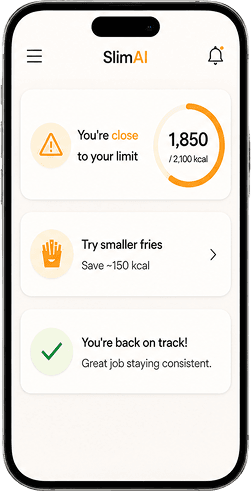
SlimAI recalculates your daily calorie target each time you log a weigh-in, so the deficit holds as you lose — and every meal you log counts against it.

3-day free trial · Cancel anytime · No card charged during trial
A projection from standard equations, not a promise. Real loss is faster in the first week or two (water) and uneven after that. Maintenance is estimated with Mifflin-St Jeor; individual metabolism varies by around 10%. Not medical advice.
Choosing a Pace
Faster is not always sooner. The pace you can hold for months beats the one you abandon in week three.
0.5 lb (0.25 kg) a week
A deficit of about 250–275 calories a day. Easy on appetite and training, and the best choice when you have under 10 lb to lose.
1 lb (0.5 kg) a week
About 500–550 calories a day below maintenance. The pace most people can hold without wrecking sleep, mood or workouts.
1.5–2 lb (0.75–1 kg) a week
A deficit of about 750–1,100 calories a day. Usually only realistic with a lot to lose; the calculator caps it at 1,000 calories and 35% of maintenance.
Why the same calories stop working
Every kilogram you lose lowers your resting energy expenditure, by roughly 10 calories a day in the Mifflin-St Jeor equation before activity is counted. Lose 13 kg and maintenance can be 150–200 calories lower than when you started.
If you keep eating your day-one target, that shrinking gap is the deficit, so each week loses a little less than the one before. Modelling work published in The Lancet showed that the old "3,500 calories per pound" rule overestimates long-term loss for exactly this reason.
The straight line only happens if your target keeps up
SlimAI builds your daily calorie goal from your current weight and recalculates it when your weight changes, so the deficit holds as you lose — and every meal you log counts against it.
3-day free trial · Cancel anytime · No card charged during trial
Picking a pace you can hold
The CDC describes gradual, steady loss of about 1 to 2 pounds a week as more likely to be kept off. For most people that is a deficit of 500–1,000 calories a day.
This calculator caps the deficit at 1,000 calories a day and at 35% of maintenance — the same limits SlimAI applies when it sets a weight-loss target. If the pace you choose needs more than that, the projection uses the capped figure and tells you.
What the scale will actually do
The first week usually drops faster than the plan, mostly from water stored with carbohydrate. After that, the line is jagged: water, salt, sleep and the menstrual cycle move the scale by a kilogram or more on any given morning.
Judge progress on weekly averages, not single days. Two flat weeks are normal; three flat weeks with an unchanged calorie target usually means the target needs recalculating.
How Long to Lose Weight at Each Pace
Weeks to lose a given amount when the calorie target is recalculated as you go. Eating the same calories throughout takes longer.
| To lose | 0.5 lb / week | 1 lb / week | 1.5 lb / week | 2 lb / week |
|---|---|---|---|---|
| 10 lb (4.5 kg) | 20 weeks | 10 weeks | 7 weeks | 5 weeks |
| 20 lb (9 kg) | 40 weeks | 20 weeks | 13 weeks | 10 weeks |
| 30 lb (13.6 kg) | 60 weeks | 30 weeks | 20 weeks | 15 weeks |
| 40 lb (18.1 kg) | 80 weeks | 40 weeks | 27 weeks | 20 weeks |
| 50 lb (22.7 kg) | 100 weeks | 50 weeks | 33 weeks | 25 weeks |
The faster paces need a deficit of about 750–1,000 calories a day, which lighter people cannot reach under the 35%-of-maintenance cap. Example of the slowdown: a 40-year-old, 178 cm, lightly active man going from 230 to 200 lb at 1 lb a week takes about 30 weeks with a recalculated target and about 37 on a fixed 2,200 calories.
How to Work Out Your Goal Date
The simple version is one division. The honest version adds one more step.
- 1
Work out how much to lose
Current weight minus goal weight. 230 lb to 200 lb is 30 lb.
- 2
Choose a weekly pace
1 lb a week needs a deficit of about 500 calories a day; 2 lb needs about 1,000.
- 3
Divide
30 lb ÷ 1 lb a week = 30 weeks, or about seven months.
- 4
Plan to recalculate
Update your calorie target every 4–5 kg (10 lb) or so. Without it, the 30 weeks stretches toward 37.
The Model Behind This Calculator
Computed in your browser. Nothing is uploaded and nothing is stored between visits.
Deficit for your pace
deficit = pace (kg/week) × 7700 ÷ 7Capped at 1,000 kcal and at 35% of maintenance — the same limits SlimAI uses.
Recalculated target (straight line)
weeks = weight to lose ÷ paceThe deficit is held constant because the target follows your weight.
Fixed intake (curved line)
each week: loss = (maintenance(weight) − intake) × 7 ÷ 7700Maintenance is Mifflin-St Jeor × activity at that week’s weight, so loss slows as you shrink.
Calorie floor
warn if intake < 1,200 (women) or 1,500 (men)The usual lowest intake recommended without medical supervision.
Sources and method
- Hall KD et al. (2011) — The Lancet — Modelled how energy expenditure adapts as weight changes and showed why fixed rules such as "3,500 calories per pound" overestimate long-term weight loss. The basis of the NIH Body Weight Planner.
- Mifflin MD et al. (1990) — American Journal of Clinical Nutrition — The resting energy equation used to estimate maintenance at each week’s weight.
- US Centers for Disease Control and Prevention — Losing weight — Describes gradual, steady loss of about 1 to 2 pounds a week as more likely to be kept off.
 FAQ

Still Wondering About SlimAI
 How long does it take to lose 20 pounds?

How long does it take to lose 20 pounds?About 20 weeks at 1 lb a week, or 10–13 weeks at 1.5–2 lb a week, if your calorie target is recalculated as you lose. Eating the same calories the whole way adds several weeks.
How long does it take to lose 30 pounds?
How long does it take to lose 30 pounds?About 30 weeks at 1 lb a week and 20 weeks at 1.5 lb a week with a recalculated target. For a 230 lb man eating a fixed 2,200 calories, the same 30 lb takes about 37 weeks.
Why is my weight loss slowing down?
Why is my weight loss slowing down?Because a lighter body burns fewer calories. If your intake has stayed the same, your deficit has shrunk with every pound lost. Recalculating your target for your current weight usually restarts steady progress.
Is losing 2 pounds a week safe?
Is losing 2 pounds a week safe?For people with a lot to lose, often yes — the CDC describes 1–2 lb a week as a reasonable pace. For lighter people, 2 lb a week needs a deficit that may push intake too low; this calculator caps the deficit at 35% of maintenance and warns below 1,200 (women) or 1,500 (men) calories.
Why did I lose more in the first week?
Why did I lose more in the first week?Much of it is water. Cutting calories, and especially carbohydrate, releases water stored with glycogen. Fat loss after the first week or two follows the deficit more closely.
How accurate is a weight loss date?
How accurate is a weight loss date?It is a projection, not a promise. Maintenance equations are typically within about 10% for an individual, and real weight moves unevenly. Use the date as a planning guide and check it against your weekly averages after a month.
Does SlimAI adjust my calories as I lose weight?
Does SlimAI adjust my calories as I lose weight?Your SlimAI calorie goal is built from your current weight, goal and pace, and it is recalculated when your weight changes — the straight line on this page rather than the curved one.
Start logging smarter with AI Meal Logging.
Log any meal, any way. Get instant calories and macros. Build the habit that sticks.
Free 3-day trial, then $7.99/month or $29.99/year. Cancel anytime.
- 50K+ food items in the food database
- 10K+ downloads on iOS and Android
- 7 languages
- 4.5★ App Store · 4.8★ Google Play (as of September 3, 2026)