


 free calculatorno signup needed
Free TDEE Calculator
Work out your basal metabolic rate, your total daily energy expenditure, and the calorie target that matches your goal — loss, maintenance, or gain — in one screen.
Short answer
TDEE (total daily energy expenditure) is the number of calories you burn in a day, including everything you do. It is calculated by working out your BMR — the calories you burn at complete rest — and multiplying it by an activity factor from 1.2 for sedentary to 1.9 for extra active. Eating at your TDEE holds your weight; eating below it loses weight; eating above it gains weight.
Almost every calorie goal you have ever been given traces back to this one number. Get TDEE roughly right and a deficit or surplus becomes arithmetic. Get it wrong and you will spend months wondering why the scale is not moving.
Every formula here is a population estimate. Two people with identical inputs can differ by 200–300 calories a day in reality, which is why the last step is always to check the estimate against what actually happens to your weight.

3-day free trial · Cancel anytime · No card charged during trial
TDEE Calculator
Your maintenance calories, and the daily target that moves you toward your goal. Runs entirely in your browser.
Count everything you actually do in a week, not what you plan to do.
About 0.5 kg (1.1 lb) a week — the pace most people can hold without wrecking training or mood.
Leave blank to use Mifflin-St Jeor. Enter a figure and the calculator switches to Katch-McArdle, which works from lean mass and is more accurate at the extremes.
Daily calorie target
2130 kcal
−0.5 kg / week · lose weight
- TDEE (maintenance) 2680 kcal
- Your target 2130 kcal
- BMR (at rest) 1729 kcal
Turn this into meals
A calorie number on its own is hard to eat. Split it into protein, carbohydrate, and fat with the macro calculator, then check your fluid target with the water intake calculator.
Your TDEE moves as your body does.
Sign up and SlimAI recalculates this target as your weight, activity, and body composition change — then counts every meal against it automatically.

3-day free trial · Cancel anytime · No card charged during trial
TDEE is an estimate from population formulas, not a measurement of your metabolism. Real intake needs adjusting against real results after two to three weeks. Not medical advice.
Turning TDEE Into a Weight Loss, Gain, or Maintenance Plan
TDEE is the pivot point. Everything else is a decision about how far above or below it you want to sit, and for how long. Roughly 7,700 calories equals one kilogram of body fat, which is where the daily adjustments below come from.
Subtract, but subtract less than you think
A 550 kcal daily deficit works out to about 0.5 kg a week — the pace most people can hold without wrecking training, sleep, or mood. Bigger deficits do work faster, and they also cost more lean mass and are far harder to sustain. Keep protein high, keep resistance training in, and never let the target drop below roughly 1,200 kcal (female) or 1,500 kcal (male) without professional supervision.
Add a little, and let training decide where it goes
A surplus of 250–350 kcal a day supports around 0.25 kg of gain a week. That is deliberately slow: past a certain point, extra calories stop adding muscle and start adding fat. Pair the surplus with progressive resistance training and 1.6–2.2 g of protein per kg of body weight, and re-check the number every few kilograms — TDEE rises as you get heavier.
Eat at TDEE and let composition change underneath it
Maintenance is not a holding pattern. Eating at TDEE while training hard and eating enough protein is how body recomposition happens — fat down, lean mass up, scale weight roughly flat. It is also the right setting for a diet break after a long deficit, which most people need more often than they take.
BMR, TDEE, and the Four Parts of Your Daily Burn
Your daily energy expenditure breaks into four components, and only one of them is exercise.
BMR — basal metabolic rate — is the largest piece, typically 60–70% of the total. It is what your body spends keeping you alive at complete rest: circulation, breathing, brain, organ function, cell maintenance. It scales mostly with lean body mass, which is why heavier and more muscular people have higher BMRs.
The thermic effect of food accounts for roughly 10%: the energy cost of digesting and processing what you eat. Protein costs the most to process, which is one of several reasons higher-protein diets tend to perform well for fat loss.
Then there is exercise activity (deliberate training) and non-exercise activity thermogenesis, or NEAT — walking, fidgeting, standing, housework, everything you do that is not a workout. NEAT varies enormously between individuals and tends to fall quietly during a long calorie deficit, which is a large part of why weight loss slows down over time.
BMR — 60–70%
The cost of staying alive at rest. Driven mainly by lean mass, and the reason muscle is worth protecting in a deficit.
Thermic effect of food — ~10%
The energy used to digest and absorb food. Highest for protein, lowest for fat.
Exercise activity — highly variable
Structured training. Usually a smaller share of the total than people expect.
NEAT — highly variable
Everything else you do while awake. Can differ by hundreds of calories a day between two similar people.
A calorie target only works if something counts against it.
SlimAI logs meals by photo, voice, text, or barcode and runs every one against the target you set — no manual arithmetic.
3-day free trial · Cancel anytime · No card charged during trial
Mifflin-St Jeor vs Katch-McArdle: Which Formula Applies to You
This calculator uses Mifflin-St Jeor by default. Published in 1990, it replaced the older Harris-Benedict equation as the standard because it proved more accurate for modern populations, and it needs only sex, age, height, and weight.
If you enter a body-fat percentage, the calculator switches to Katch-McArdle instead. That formula works from lean body mass rather than total weight, which makes it noticeably better at the extremes — very lean, very muscular, or carrying a lot of fat — because it does not assume a typical body composition.
Neither is a measurement. Published comparisons put predictive equations within roughly 10% of measured resting energy expenditure for most people, which at a 2,400 kcal TDEE is a ±240 kcal band. That is why the estimate is a starting point, not a verdict.
Picking an Activity Multiplier Honestly
The activity multiplier is where most TDEE calculations go wrong, and it always goes wrong in the same direction: upward.
Three gym sessions a week does not make a desk-based week "very active". If you sit for eight hours, drive, and train three times a week, you are moderately active at most — and if your step count outside training is under 5,000, sedentary-to-light is closer to the truth.
When in doubt, pick the lower option. Underestimating slightly means you eat a little less than maintenance and lose slowly, which is easy to correct upward. Overestimating means a deficit you think exists but does not, and weeks of confusion about why nothing is happening.
Count the whole week
Two hard sessions and five sedentary days average out to something well below "very active".
Your job counts
Hospitality, trades, warehouse, and nursing work push NEAT far above a desk-based baseline before any training is added.
Steps are a better proxy than sessions
Under 5,000 steps is sedentary. 7,500–10,000 with regular training is genuinely moderate.
Verify with the scale
Two to three weeks of consistent logging tells you more than any multiplier. If weight is flat, you are at your real TDEE.
What Happens After You Get the Number
A TDEE estimate is only useful if something measures against it. That is the step most people skip: they calculate a target, eat approximately, and conclude weeks later that the calculator was wrong when the real issue was that nothing was ever counted.
SlimAI Calorie Tracker takes the same inputs you just entered — sex, age, height, weight, activity level, goal and pace, target weight, body type, preferred diet — during a short setup, and produces a daily calorie goal with gram-level protein, carbohydrate, and fat targets. You can override any of it and set your own numbers instead.
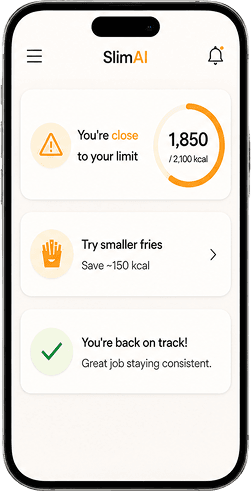
From there, logging is the only manual step, and it is deliberately fast: photo, voice, text, barcode, nutrition label, or database search. The daily dashboard shows calories eaten, your goal, and calories burned in one ring, with per-meal ranges telling you how much is left and which meals are still owed.
Your TDEE is not static. It falls as you lose weight, rises as you gain, and shifts with activity. Because SlimAI holds your profile, the target moves with you instead of going stale the moment you close this tab.
Activity Multipliers Explained
Your BMR is multiplied by one of these factors to produce TDEE. The descriptions matter more than the labels — pick the row that matches your whole week, not your best week.
| Activity level | Multiplier | Who this actually describes |
|---|---|---|
| Sedentary | × 1.20 | Desk job, under 5,000 steps a day, no structured training |
| Lightly active | × 1.375 | Walking most days plus one to three easy sessions a week |
| Moderately active | × 1.55 | Training on most weekdays, or an active job with steady movement |
| Very active | × 1.725 | Hard training six or seven days a week, or a physical job plus regular sessions |
| Extra active | × 1.90 | Manual labour, endurance blocks, or two training sessions a day |
These multipliers are conventional values used across the fitness industry rather than a single published standard. If your weight is not moving as predicted after two to three weeks of consistent logging, the multiplier is usually the input to change first.
How to Calculate Your TDEE
Two steps of arithmetic, then one decision. The calculator above does the first two and offers the third as a dropdown.
- 1
Calculate your BMR
Using Mifflin-St Jeor: for men, BMR = 10 × weight(kg) + 6.25 × height(cm) − 5 × age + 5. For women, the same expression ends in −161. A 35-year-old woman at 70 kg and 165 cm has a BMR of 700 + 1031 − 175 − 161 = 1,395 kcal.
- 2
Choose your activity multiplier honestly
Match your entire week against the table above, not your most active week. If you are between two rows, take the lower one.
- 3
Multiply to get TDEE
That same woman, moderately active, has a TDEE of 1,395 × 1.55 = 2,162 kcal. That is her maintenance intake — the point where weight holds steady.
- 4
Adjust for your goal
Subtract about 550 kcal a day to lose roughly 0.5 kg a week, or add 250–350 kcal to gain around 0.25 kg a week. One kilogram of body fat is roughly 7,700 kcal, so a weekly rate divided by seven gives the daily adjustment.
- 5
Test it against reality for two to three weeks
Log consistently and track your weekly average weight. If it is not moving the way the estimate predicted, adjust intake by 100–200 kcal and give it another two weeks. Real data beats any formula.
The Formulas Behind This Calculator
Everything runs in your browser. No inputs are uploaded, and nothing is stored between visits.
Mifflin-St Jeor (male)
BMR = 10×weight(kg) + 6.25×height(cm) − 5×age + 5The default when no body-fat percentage is supplied.
Mifflin-St Jeor (female)
BMR = 10×weight(kg) + 6.25×height(cm) − 5×age − 161Same expression, different constant.
Katch-McArdle
BMR = 370 + 21.6 × leanMass(kg) · leanMass = weight × (1 − bodyFat%/100)Used automatically when you enter a body-fat percentage. More accurate for very lean or very muscular people.
TDEE and goal target
TDEE = BMR × activityFactor · target = TDEE + (rate(kg/week) × 7700 / 7)A negative rate produces a deficit, a positive rate a surplus. Loss targets are floored at 1,200 kcal (female) and 1,500 kcal (male).
Sources and method
- Mifflin MD, St Jeor ST, et al. (1990) — A new predictive equation for resting energy expenditure in healthy individuals — the default BMR formula used here.
- Katch F, McArdle W — lean-mass BMR equation — Used when a body-fat percentage is entered, since it derives resting expenditure from lean body mass rather than total weight.
- Wishnofsky, M. (1958) — The approximation of roughly 7,700 kcal per kilogram of body fat, which converts a weekly rate of change into a daily calorie adjustment. It is a simplification and overstates loss over long periods.
- Levine, J. — non-exercise activity thermogenesis — Research on NEAT and its variability between individuals, and its tendency to decline during sustained calorie restriction.
 FAQ
FAQ
Still Wondering About SlimAI
 What is TDEE?
What is TDEE?TDEE stands for total daily energy expenditure — the total number of calories your body uses in a day. It combines your basal metabolic rate, the energy cost of digesting food, deliberate exercise, and all the incidental movement you do while awake. Eating at your TDEE maintains your weight, eating below it loses weight, and eating above it gains weight.
How is TDEE calculated?
How is TDEE calculated?First calculate BMR, usually with the Mifflin-St Jeor equation: 10 × weight in kg + 6.25 × height in cm − 5 × age, then +5 for men or −161 for women. Then multiply BMR by an activity factor between 1.2 (sedentary) and 1.9 (extra active). If you know your body-fat percentage, the Katch-McArdle equation (370 + 21.6 × lean mass in kg) is generally more accurate.
How many calories should I eat to lose weight?
How many calories should I eat to lose weight?Take your TDEE and subtract about 550 calories a day for roughly 0.5 kg of loss per week, since a kilogram of body fat is approximately 7,700 calories. Larger deficits lose faster but cost more lean mass and are harder to sustain. Most guidance sets a floor of about 1,200 kcal a day for women and 1,500 for men unless a health professional is supervising.
Is TDEE the same as BMR?
Is TDEE the same as BMR?No. BMR is what you burn at complete rest — typically 60–70% of the total. TDEE is BMR plus digestion, exercise, and all your incidental daily movement. TDEE is always higher, usually by 20% to 90% depending on how active you are.
How accurate is a TDEE calculator?
How accurate is a TDEE calculator?Predictive equations land within roughly 10% of measured resting energy expenditure for most people, which at a 2,400 kcal TDEE is a band of about ±240 kcal. Treat the output as a starting point: log consistently for two to three weeks, watch your weekly average weight, and adjust intake by 100–200 kcal if reality disagrees with the estimate.
Does TDEE change over time?
Does TDEE change over time?Yes. It falls as you lose weight, because a smaller body costs less to run, and it rises as you gain. Sustained dieting also reduces incidental daily movement, which lowers TDEE further than body-weight change alone would predict. Recalculate every four to five kilograms of change, or let an app that holds your profile do it continuously.
Should I eat back calories burned from exercise?
Should I eat back calories burned from exercise?If you chose an activity multiplier that already accounts for your training, exercise is included in the number and eating it back a second time double-counts it. SlimAI has an explicit Add Back Calories Burned setting you control, so you decide whether workout burn adjusts your remaining calories for the day.
Does SlimAI calculate TDEE for me?
Does SlimAI calculate TDEE for me?Yes. During setup, SlimAI Calorie Tracker takes your sex, age, height, weight, activity level, goal and pace, target weight, body type, and preferred diet, and produces a daily calorie goal with gram-level protein, carbohydrate, and fat targets. You can override any figure and set your own. Because the profile is stored, the target updates as your weight and activity change rather than going stale.
Start logging smarter with AI Meal Logging.
Log any meal, any way. Get instant calories and macros. Build the habit that sticks.
Free 3-day trial, then $7.99/month or $29.99/year. Cancel anytime.
- 50K+ food items in the food database
- 10K+ downloads on iOS and Android
- 7 languages
- 4.5★ App Store · 4.8★ Google Play (as of September 3, 2026)