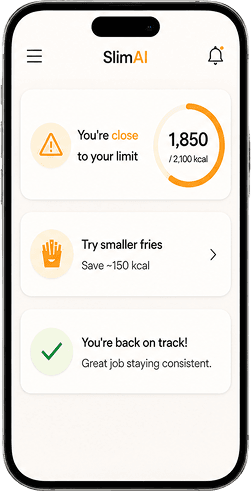



 featureAdaptive Calorie Goals
Adaptive Calorie Goals: SlimAI Changes the Plan When It Stops Working
When your weight has been flat for two weeks and your logging has been solid, SlimAI says so and offers two ways forward — one small calorie step or 2,000 more steps a day. Neither happens without your tap.
Every calorie target expires. The number you were given on day one was computed for the body you had on day one, and a body that has lost weight burns less than it did. Nothing about a fixed target tells you when that moment arrives.
Adaptive Calorie Goals is the coaching move that most trackers never make: detect the stall, distinguish it from a logging problem, and propose exactly one change — inside hard safety limits, and never applied on its own.
This is the half of adaptation that SlimAI has to start, because you changed nothing. The other half — what happens when you do change something, and your whole plan is recomputed around it — is covered on Adaptive Plan.
Last updated

3-day free trial · Cancel anytime · No card charged during trial
The Three Ways Your Calorie Target Actually Moves
Most trackers adapt in one way, if at all. SlimAI adapts in three, and they operate on different timescales — which is worth stating plainly, because they are documented on separate pages and are easy to mistake for one feature.
Within the day, activity moves the number. Logged workouts produce an estimated burn from their duration and intensity, and steps sync from Apple Health or Health Connect. Whether that burn is added back to what you can still eat is a setting you control — Add Back Calories Burned exists because people genuinely disagree about eating exercise back, and both positions are defensible. Turn it on and your available intake rises as you move.
Between days, your own inputs move it. Log a weigh-in that is your latest reading, or edit your goal, target date, pace, activity level, body type, cuisine or health details, and the same calculation that produced your original target runs again — updating your calorie goal, macro grams, per-meal budgets, BMI, diet plan, stats, coach and widgets in one save, with the new number shown live before you commit to it.
Across weeks, a stall moves it — but only under conditions. That is what the rest of this page is about, and it is the one adaptation SlimAI starts on its own rather than waiting for you.
What SlimAI deliberately does not do is infer your true energy expenditure from the gap between what you logged eating and how your weight actually moved, then quietly rewrite your target from that inference. Apps built around that approach exist and it is a legitimate design. It also compounds every logging error you make, which is why SlimAI requires solid adherence before it will touch your target at all.
A Stall Is Not Automatically a Plateau
This is where most "adaptive" features go wrong. Weight stops moving, the app cuts calories, and the user — who has actually just been logging half their meals — gets a lower target they were already exceeding without knowing it. That makes everything worse.
SlimAI requires two conditions before it will call anything a plateau: your smoothed weight trend has been effectively flat for at least 14 days, and your adherence over that period has been good. Both, not either.
When the trend is flat but the logging is not, that is not a plateau — it is a data problem, and SlimAI routes you to consistency help instead of touching your calorie target.
Ready to try Adaptive Calorie Goals?
Snap a photo and SlimAI does the rest — 10K+ downloads on iOS and Android.
3-day free trial · Cancel anytime · No card charged during trial
Two Options, and You Pick
When a real plateau is detected, SlimAI proposes two paths and applies neither until you confirm.
Lower your calorie target by one small step
A single conservative reduction, bounded by every guardrail below. You see the current number and the proposed number side by side before anything changes.
Add 2,000 steps a day
The path that changes nothing about your food. Choosing it writes no new target at all — it is a behaviour suggestion, not a settings change.
Or neither
Dismissing the proposal is a valid answer. Nothing is penalised, and the detection will surface again if the plateau persists.
And you can undo it
An accepted change is reversible inline. The undo restores your exact previous target through the same path that set it — not an approximation of it.
The Guardrails, All of Them Hard Limits
Calorie targets are the one place a health app can do real harm quickly. These limits are enforced in code, not written on a marketing page and hoped for.
A calorie floor that is never crossed
SlimAI will not propose a target below its gender-aware floor, regardless of what the arithmetic suggests. If the math wants to go lower, the proposal simply does not appear.
Propose, never auto-apply
No target ever changes on its own. Every change requires an explicit confirmation with the before and after visible.
A rate cap around 1% of bodyweight per week
Nothing SlimAI proposes implies a faster rate of loss than that, which keeps the suggested step conservative for small users as well as large ones.
Medical conditions suppress the numbers entirely
If your profile carries a medical condition — including pregnancy or breastfeeding — SlimAI does not propose a deficit at all. It points you to your clinician instead. Pregnancy also places you in the most conservative bucket in the original calorie calculation.
Why SlimAI Bounds the Step Instead of Recomputing Everything
A more impressive-looking feature would recompute your entire energy balance and hand you a new number with a decimal point on it. SlimAI does not, for a specific reason: it does not store a measured metabolic rate, and inventing one to justify a precise-looking target would be worse than a conservative step.
So the proposal is bounded rather than derived — one small change, capped, floored, and reversible. That is a deliberate accuracy trade, and it is why the copy never promises a personalised metabolism model it does not have.
It Writes the Same Fields You Would Write Yourself
An accepted target lands through the same mechanism as SlimAI's manual custom goal editor — the same calorie field, the same protein, fat, and carbohydrate grams, and the same manual flag. There is no parallel "adaptive" number living somewhere else in the app.
That means everything downstream behaves normally: your daily dashboard, your macro ring, your weekly adherence score, and every chart read the new target the moment it saves. And if you prefer to set targets yourself, custom calorie and macro goals stay available and always override.
This Is Not Medical Advice
Adaptive Calorie Goals is a tracking tool that proposes conservative adjustments based on your own logged data. It does not diagnose anything, does not account for medication, illness, sleep, stress, menstrual cycle, or thyroid function, and is not a substitute for professional guidance.
If your weight has stalled for a long period, if you have a medical condition, if you are pregnant or breastfeeding, or if you have a history of disordered eating, speak to a qualified health professional before changing your calorie intake. SlimAI states this on the proposal surface itself, not only in the small print.
Explore More SlimAI Features
 FAQ
FAQ
Still Wondering About SlimAI
 How does SlimAI detect a weight loss plateau?
How does SlimAI detect a weight loss plateau?SlimAI requires two conditions together: your smoothed weight trend has been effectively flat — under roughly 0.1 kg per week — for at least 14 days, and your logging adherence over that period has been good. If the trend is flat but your logging has been patchy, SlimAI does not call it a plateau; it treats it as a data problem and offers consistency help instead of changing your calorie target.
Does SlimAI change my calorie goal automatically?
Does SlimAI change my calorie goal automatically?No. SlimAI proposes and you decide. When a plateau is detected you are offered two options — lower your calorie target by one small step, or add 2,000 steps a day — and neither is applied until you explicitly confirm. The steps option writes nothing to your settings at all. An accepted change can be undone inline, restoring your exact previous target.
How low can SlimAI suggest my calories go?
How low can SlimAI suggest my calories go?Never below a fixed calorie floor, which is gender-aware and enforced in code. If the arithmetic points below that floor, no proposal is shown at all. Any proposed step is additionally capped so it never implies more than roughly 1% of bodyweight lost per week.
What if I have a medical condition or I am pregnant?
What if I have a medical condition or I am pregnant?SlimAI suppresses numeric deficit and plateau advice entirely. If your profile carries a medical condition — and pregnancy or breastfeeding counts as one — you are pointed toward a qualified clinician rather than shown a number. Pregnancy also places you in the most conservative bucket of SlimAI's original calorie calculation.
Can I still set my own calorie and macro targets?
Can I still set my own calorie and macro targets?Yes. Custom calorie and macro goals remain fully available and always take priority. An accepted adaptive target writes to exactly the same fields the manual editor uses, so there is no separate number hidden elsewhere in the app and you can overwrite it at any time.
Are Adaptive Calorie Goals free in SlimAI?
Are Adaptive Calorie Goals free in SlimAI?Plateau detection with the adaptive target proposal is part of SlimAI Pro. Your calorie target, the daily dashboard, and weight tracking are available without it.
Start logging smarter with AI Meal Logging.
Log any meal, any way. Get instant calories and macros. Build the habit that sticks.
Free 3-day trial, then $7.99/month or $29.99/year. Cancel anytime.
- 50K+ food items in the food database
- 10K+ downloads on iOS and Android
- 7 languages
- 4.5★ App Store · 4.8★ Google Play (as of September 3, 2026)