


SlimAI vs GainFrame: Physique Scoring, or a Body Fat Estimate Attached to the Log That Moves It?
Short answer
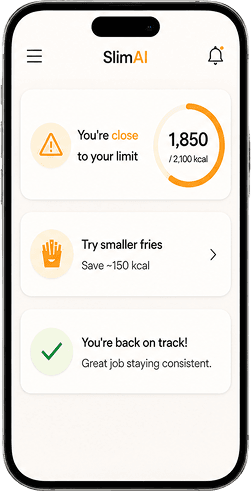
GainFrame scores physique: twelve muscle groups, FFMI, and a projection of how you might look later. SlimAI scores no muscle groups. SlimAI estimates body fat from two photos and wires that estimate to the food log that moves it, alongside AI meal logging, macro targets, fasting, water, steps and workouts on iOS and Android.
These two apps point the same camera at the same problem and stop in different places.
GainFrame is a physique-analysis app. Per its public listings as of August 2026, it reads a progress photo and returns an estimated body fat percentage, FFMI, lean mass, and individual scores for twelve muscle groups, then builds a photo timeline around them with alignment tools, background removal, and a Future You projection. It is iPhone-only, with a free tier and a paid Pro subscription.
SlimAI Calorie Tracker starts from the other end. AI Body Assessment estimates body-fat percentage, fat mass, lean mass, and regional fat distribution from two guided photos or six tape measurements, using published formulas — the US Navy circumference method, Relative Fat Mass, and CUN-BAE — and reports the result as a likely range with a confidence rating rather than a single hard number.
What sits underneath it is the difference. In SlimAI that body-fat estimate lives next to the food log, the calorie target, the macro grams, the fasting window, the water, the steps, and the workouts that actually change it — on iOS and Android, with no hardware and no second app.
If you lift and you want your back rated separately from your chest, GainFrame does something SlimAI does not. If you want to know your body fat percentage and then have somewhere to act on it, that is the case for SlimAI.
Last updated

3-day free trial · Cancel anytime · No card charged during trial
Quick Verdict: SlimAI vs GainFrame
Choose SlimAI if you want a body-fat estimate connected to the thing that moves it: AI meal logging by photo, voice, text, barcode, or search, a daily calorie goal with gram-level macro targets, per-meal budgets, fasting, water, steps, and workouts, plus AI Coach reading the week back to you — on iOS and Android for $7.99/month or $29.99/year.
Choose GainFrame if your priority is physique analysis specifically: twelve muscle-group scores, FFMI, a composite physique score, side-by-side progress photo comparison with alignment and background removal, and a projection of how you might look in three, six, or twelve months. Nothing in SlimAI scores individual muscle groups.
GainFrame is iPhone-only as of August 2026, per its App Store listing. If you are on Android, this comparison resolves itself.
Both apps are explicit that a photo estimate is not a DEXA scan. GainFrame publishes a single user comparison — 19% estimated against 18.6% measured — and states plainly that it is one test, not a validation study. SlimAI names the peer-reviewed formulas it runs and shows a likely range instead of implying precision it does not have.
The honest summary: GainFrame goes deeper on the physique. SlimAI goes wider on the routine. Body fat percentage does not move because you measured it — it moves because of what you ate and how you trained, and only one of these two apps tracks that.
Where SlimAI Comes Out Ahead
Across 14 points of comparison, SlimAI leads on 8, is comparable on 2, and GainFrame leads on 4. The differences below are the ones that change how your day actually goes.
The estimate sits next to the lever that moves it
A body fat reading is a diagnosis. Calories and protein are the treatment. In SlimAI both live in one app: your body-fat trend runs alongside your calorie goal, your macro grams, your logged meals, and your training, so a rising fat mass has an obvious next action rather than being an interesting number you look at monthly. GainFrame reads nutrition data through Apple Health for its Coach AI, but food logging is not what it is for.
iOS and Android, no hardware, no second app
SlimAI runs on iPhone and Android. GainFrame is listed as iPhone-only (with Mac support on Apple silicon) as of August 2026. For anyone on Android, or anyone who does not want their body-composition history stranded on one platform, that is the whole decision.
Published formulas and an honest range
SlimAI Body Assessment names what it runs — US Navy circumference method, Relative Fat Mass, CUN-BAE — and returns a likely range with a confidence rating, because circumference-based estimates carry a standard error of roughly 3.5 percentage points. A single decimal figure implies a precision no photo-based method has.
A tape-measure mode for people who do not want to be photographed
SlimAI accepts six manually entered measurements and runs the same formulas, so you can get a body-fat estimate without taking a single photo. That matters more than it sounds: a body-composition tool that requires a photo of you in minimal clothing is one many people simply never use twice.
The week gets read back, not just the photo
AI Coach turns your logged week into a smoothed weight trajectory, the meal type and weekdays that drove your calories, a 0–100 weekly score, one win and at most one thing to watch, and a single next action that opens the right screen prefilled — plus a written report every Monday. It is rule-based rather than generated, so the same week always produces the same sentence, and every rule stays silent below its minimum sample instead of guessing.
One subscription covers the whole routine
SlimAI Pro is $7.99/month or $29.99/year with a 3-day free trial, and it covers unlimited AI scans, AI Body Assessment photo analysis, fasting, water, workouts, steps, diet plans, food swaps, and plateau detection. GainFrame offers a free tier with a limited lifetime photo allowance plus a paid Pro subscription; check its App Store listing for current pricing, which has changed since launch.
Seen enough? Try SlimAI against GainFrame yourself.
Log the same three days in both. Free 3-day trial, then $29.99/year — under $3 a month.
3-day free trial · Cancel anytime · No card charged during trial
SlimAI vs GainFrame: Feature-by-Feature Comparison
Each row names what both apps offer and who it favours. Rows where GainFrame leads are marked as clearly as the rows where SlimAI does.
| What you are comparing | GainFrame | SlimAI |
|---|---|---|
| Body composition | ||
| Photo-based body fat estimateBoth apps do this, and both are estimates. The question is what the number is attached to.Comparable | GainFramePhoto analysis returns an estimated body fat percentage alongside FFMI and lean mass, per public feature descriptions as of August 2026. | SlimAIAI Body Assessment estimates body-fat percentage, fat mass, lean mass, and regional fat distribution from two guided photos, returned as a likely range with a confidence rating. |
| Muscle-group level scoringFor a lifter mid-programme, knowing which body part is lagging is a training decision, not a vanity metric.GainFrame leads | GainFrameScores twelve individual muscle groups plus a composite score, per public feature descriptions. This is the clearest thing GainFrame does that SlimAI does not. | SlimAINot offered. SlimAI reports regional fat distribution but does not score individual muscle groups or produce a composite physique score. |
| FFMI (Fat-Free Mass Index)FFMI normalises lean mass for height, which is how lifters judge whether a bulk is working.GainFrame leads | GainFrameReports FFMI directly as part of the physique breakdown. | SlimAIReports lean mass in kilograms or pounds and tracks it over time, but does not compute FFMI. |
| Photo-free optionPlenty of people will measure their body composition monthly but will not photograph themselves for it.SlimAI advantage | GainFrameThe product is built around progress photos; no tape-measure-only path is listed in publicly available descriptions. | SlimAITape-measure mode accepts six manually entered circumferences and runs the same published formulas, so no photo is required at any point. |
| Method transparencyAn estimate you cannot interrogate is a number you have to take on faith.SlimAI advantage | GainFramePublishes one user comparison, 19% estimated against 18.6% measured by DEXA, and states clearly that it is a single test rather than a validation study. The underlying method is not itemised publicly. | SlimAINames the formulas used — US Navy circumference method, Relative Fat Mass, CUN-BAE — and publishes them on the free body fat calculator, with a stated likely range and confidence rating. |
| Progress photos | ||
| Photo comparison toolingTwo photos taken four months apart are only comparable if the pose and framing line up.GainFrame leads | GainFrameSide-by-side comparison with fine alignment, one-click background removal, and Smart Import that classifies existing gym photos by pose. This is a genuinely well-built part of the product. | SlimAIStores body-scan history and shows body-fat and lean-mass trends over time, but does not offer alignment, background removal, or pose classification. |
| Forward projectionSeeing a plausible version of the outcome is a real adherence tool for some people.GainFrame leads | GainFrameFuture You generates three, six, and twelve-month scenarios from your data. | SlimAIAI Coach projects a smoothed weight trajectory and an arrival estimate, but there is no visual physique projection. |
| Food and nutrition | ||
| Calorie and macro trackingBody fat percentage is an output. Energy balance is the input, and one of these apps tracks it.SlimAI advantage | GainFrameNot a food tracker. Coach AI can read nutrition data from Apple Health, but calorie and macro logging is not part of the product. | SlimAIFull daily calorie goal with gram-level protein, carbohydrate, and fat targets, per-meal budgets, a 50K+ curated food database, and real-time portion warnings before a meal saves. |
| Ways to log a mealThe meals you cannot photograph are the ones that break a food log.SlimAI advantage | GainFrameNot applicable — meal logging is outside the product scope. | SlimAICamera Scan, Gallery Upload, Voice to Log, Type to Add, Barcode Scanner, Food Database Search, Recent and Saved Foods, and Back-Date Logging, all feeding one diary. |
| Habits | ||
| Fasting, water, steps, and workoutsComposition changes come from the whole week, not one measurement in it.SlimAI advantage | GainFrameWeekly check-ins and workout data via Apple Health, but fasting and water tracking are not listed features. | SlimAISix fasting plans, utensil-based water tracking, step tracking, and workout logging, all in the same app and all feeding the weekly pattern engine. |
| Guidance | ||
| Weekly interpretationBoth apps try to tell you what your data means; they read different data.Comparable | GainFrameCoach AI draws on check-ins, body metrics, Apple Health, workouts, and nutrition data, with automatic throwbacks against earlier check-ins. | SlimAIAI Coach returns a weight trajectory, calorie attribution by meal type and weekday, a 0–100 weekly score, one action per insight, and a written report every Monday — rule-based, so the same week always produces the same output. |
| Adaptive targets when progress stallsA plateau needs a changed number, not a louder notification.SlimAI advantage | GainFrameNo calorie target exists to adapt, since the app does not set one. | SlimAIPlateau detection proposes one confirmable, reversible change when the weight trend has been flat for fourteen days with good adherence, and the whole plan recalculates on any profile change. |
| Platform | ||
| Device supportA feature you cannot install is not a feature.SlimAI advantage | GainFrameiPhone only, requiring iOS 26.0 or later, plus Mac on Apple silicon, per the App Store listing as of August 2026. No Android version is listed. | SlimAIiPhone and Android, with seven interface languages. |
| Pricing | ||
| What the subscription coversTwo subscriptions to answer one question is a bad trade.SlimAI advantage | GainFrameFree tier with a limited lifetime photo allowance plus a paid Pro subscription. Listed pricing has changed since launch, so check the App Store for the current figure. | SlimAISlimAI Pro at $7.99/month or $29.99/year with a 3-day free trial, covering unlimited AI scans, body assessment photo analysis, fasting, water, workouts, steps, diet plans, food swaps, and plateau detection. |
Comparison based on publicly available information as of August 2026. Competitor features and pricing may change — check their official sites for the latest.
What Each App Is Actually Built To Do
GainFrame is a physique-tracking app for people who lift. Its centre of gravity is the progress photo: read the photo, score the physique, line the photos up over time, and project forward. The body fat percentage is one output among several, sitting next to FFMI, lean mass, and twelve muscle-group ratings that together describe how a training block is going.
SlimAI is a calorie tracker with body composition built into it. The centre of gravity is the daily log — what you ate, how much of your target it used, what your macros look like, whether you trained, whether you drank enough. AI Body Assessment is the measurement that tells you whether the log is working.
Neither framing is wrong, and the two products barely overlap outside the body-fat number itself. The question is which half of the loop you already have covered. If you are logging food carefully and want a physique read on top, GainFrame adds something. If you have a body-fat number and no system for changing it, a more detailed body-fat number is not the missing piece.
GainFrame reads the outcome
Twelve muscle-group scores, FFMI, composite score, and a photo timeline. Excellent detail on where you are now and how you have changed.
SlimAI reads the outcome and the input
Body fat, fat mass, lean mass, and regional distribution, alongside the calories, macros, fasting, water, steps, and training that produced them.
Only one of them is on Android
GainFrame is iPhone-only as of August 2026. SlimAI runs on both platforms in seven languages.
Only one of them scores your lats
If muscle-group-level feedback is the reason you are looking, SlimAI does not offer it and will not pretend otherwise.
How SlimAI Estimates Body Fat, and What It Refuses To Claim
SlimAI Body Assessment takes two guided photos, reads six circumference measurements from them, and runs those measurements through three published equations: the US Navy circumference method from Hodgdon and Beckett, Relative Fat Mass from Woolcott and Bergman, and CUN-BAE from Gómez-Ambrosi and colleagues. The same formulas are on the free body fat calculator on this site, with the arithmetic written out, so nothing about the method is hidden behind the app.
The result comes back as a likely range with a confidence rating, not a single decimal. That is deliberate. The Navy method carries a published standard error of roughly 3.5 percentage points against hydrostatic weighing, which means a reading of 20% honestly means somewhere around 16.5% to 23.5%. An app that reports 20.4% and stops is describing a precision that the underlying science does not support.
Where estimates like these are genuinely reliable is in tracking change. A method that reads two points high every single time still shows a four-point drop across three months perfectly well. That is why SlimAI stores every reading and plots body fat against weight — so you can watch the two lines separate during a recomposition phase, which is the one thing a scale can never show you.
None of it is a medical measurement or a diagnosis. It is a fitness estimate for healthy adults, and the app says so.
The Case for GainFrame, Stated Fairly
There is a specific person GainFrame serves better, and it is worth naming: someone on an iPhone, mid-way through a structured training block, who already has their nutrition handled and wants granular feedback on how their physique is developing.
For that person, twelve muscle-group scores are not a gimmick. Knowing that your posterior chain has moved while your shoulders have not is directly actionable in a training programme in a way that a single body fat percentage is not. FFMI adds a height-normalised view of lean mass that is the standard currency in lifting circles. And the photo tooling — alignment, background removal, Smart Import for the photos already on your camera roll — solves the real problem that progress photos taken months apart are usually not comparable.
The company is also straightforward about accuracy in a way that is unusual in this category. Publishing a single user comparison and labelling it as one test rather than a validation study is more honest than most marketing in AI body scanning.
What it does not do is track what you eat. If your body fat number is not where you want it, the app can describe the gap in considerable detail and then leaves you to close it somewhere else.
When SlimAI Is the Better Choice
The case for SlimAI is not that it analyses physiques more deeply. It does not. The case is that a body fat percentage is only useful if something changes because of it, and change comes from energy balance, protein intake, and training consistency — all of which SlimAI tracks in the same place as the measurement.
A worked example. Your assessment comes back at 26% with 19 kg of fat mass and 54 kg of lean mass. In SlimAI that is not the end of the interaction: the app already knows your maintenance calories, sets a daily target and gram-level protein goal designed to protect that 54 kg while the 19 kg comes down, counts every meal you photograph against it, and flags at week two if your protein is consistently short. Re-scan in four weeks and the trend line tells you whether the lean mass held.
It also matters that no photo is required. Tape-measure mode takes six typed measurements and produces the same estimate. For a large number of people, that is the difference between measuring body composition monthly and never measuring it at all.
And it runs on Android, which for roughly half of potential users settles the question before any of the rest of it matters.
Switching from GainFrame to SlimAI
The photo habit transfers directly. What gets added is everything that happens between measurements.
Your scan habit carries over, with a photo-free fallback
Two guided photos produce a body-fat estimate, fat mass, lean mass, and regional fat distribution. If you would rather not photograph yourself, six typed tape measurements run the same formulas and give the same output.
The measurement gains a mechanism
Your estimate lands next to a daily calorie goal, gram-level macro targets, per-meal budgets, and a food log you can fill by photo, voice, text, barcode, or search. The number stops being something you observe and becomes something you steer.
Your history stops depending on one platform
SlimAI runs on iPhone and Android in seven languages, so a phone change does not orphan your body-composition history.
Accept the trade honestly
You lose muscle-group scoring, FFMI, the photo alignment tooling, and the Future You projection. If those are the reason you opened GainFrame in the first place, keep it — the two apps do genuinely different jobs.
What SlimAI costs after the trial
$29.99 a year — under $3 a month — for one tier that covers AI scanning, body fat estimates, fasting, water, workouts, diet plans, and progress. Monthly is $7.99. Both start with a 3-day free trial and cancel from your store account.
Twelve months at the monthly price is $95.88, so yearly saves $65.89 (69% off). GainFrame pricing changes independently — check its current store listing before comparing.
Start the 3-day trial
Nothing is charged until the trial ends.

3-day free trial · Cancel anytime · No card charged during trial
What the research says about tracking apps
Independent findings, not ours
Neither of these papers tested SlimAI or GainFrame. They describe the category both apps sit in, and they are the two things worth knowing before you pick either one.
Across 90 adults tracking food in an app for eight weeks, the people who completed the study logged on 70.2% of days and lost 2.19% of body weight, against 1.54% for the sample as a whole, which logged on about half of days. Frequency of logging explained 6.8% of the variance in weight change.
A meta-analysis of 14 validation studies covering 12 dietary-record apps found every app underestimated energy intake against its reference method, pooled at −202 kcal/day (95% CI −319 to −85). Where the app and the reference used the same food-composition table, the gap fell to −57 kcal/day (95% CI −116 to 2), so most of the error came from the database rather than the app.
 FAQ
FAQ
Still Wondering About SlimAI
 Is SlimAI a good GainFrame alternative?
Is SlimAI a good GainFrame alternative?For body fat estimation, calorie tracking, and Android support, yes. SlimAI AI Body Assessment estimates body-fat percentage, fat mass, lean mass, and regional fat distribution from two photos or six tape measurements, and connects that to a full calorie, macro, fasting, water, step, and workout log on both iOS and Android. For muscle-group scoring and FFMI specifically, it is not a replacement — SlimAI does not offer those.
Is GainFrame available on Android?
Is GainFrame available on Android?Not as of August 2026. The App Store listing shows GainFrame as an iPhone app requiring iOS 26.0 or later, with additional Mac support on Apple silicon, and no Android version is listed on its website or in app-store listings. SlimAI is available on both the App Store and Google Play.
Which app estimates body fat more accurately?
Which app estimates body fat more accurately?Neither has published a peer-reviewed validation study, and both are explicit that a photo estimate is not a DEXA scan. GainFrame publishes one user comparison — 19% estimated against 18.6% measured — and labels it as a single test. SlimAI names the three published formulas it uses and reports a likely range rather than a point estimate, because the underlying circumference method carries a standard error of around 3.5 percentage points. Treat any single reading from either app as approximate and read the trend instead.
Does GainFrame track calories?
Does GainFrame track calories?No. GainFrame is a physique-analysis app; its Coach AI can read nutrition data through Apple Health, but calorie and macro logging is not part of the product. SlimAI includes full food logging by photo, voice, text, barcode, and database search, with a daily calorie goal, gram-level macro targets, and per-meal budgets.
Does SlimAI score individual muscle groups?
Does SlimAI score individual muscle groups?No. SlimAI Body Assessment reports body-fat percentage, fat mass, lean mass, and regional fat distribution, but it does not rate individual muscle groups or produce a composite physique score. If muscle-group-level feedback is your main requirement, GainFrame does that and SlimAI does not.
Can I estimate body fat without taking photos?
Can I estimate body fat without taking photos?In SlimAI, yes. Tape-measure mode accepts six manually entered circumference measurements and runs the same US Navy, RFM, and CUN-BAE formulas, so you get a body-fat estimate with no photos involved. You can also try the calculation for free on the SlimAI body fat calculator before installing anything.
How much does each app cost?
How much does each app cost?SlimAI Pro is $7.99 per month or $29.99 per year with a 3-day free trial, covering unlimited AI scans, body assessment photo analysis, fasting, water, workouts, steps, diet plans, food swaps, and plateau detection. GainFrame offers a free tier with a limited lifetime photo allowance plus a paid Pro subscription; its listed pricing has changed since launch, so check the App Store for the current figure before subscribing.
Can I use both apps together?
Can I use both apps together?Yes, and for a lifter on an iPhone that is a reasonable setup — GainFrame for muscle-group and FFMI detail, SlimAI for the calories, macros, and habits that drive the change. The trade-off is two subscriptions and two body-fat histories that will not agree with each other, since the methods differ. If you do run both, pick one as your reference for trend purposes and treat the other as supplementary.
Make the switch from GainFrame with AI Meal Logging.
Log your next meal in SlimAI and see the difference on day one. Free for three days.
Free 3-day trial, then $7.99/month or $29.99/year. Cancel anytime.
- 50K+ food items in the food database
- 10K+ downloads on iOS and Android
- 7 languages
- 4.5★ App Store · 4.8★ Google Play (as of September 3, 2026)