



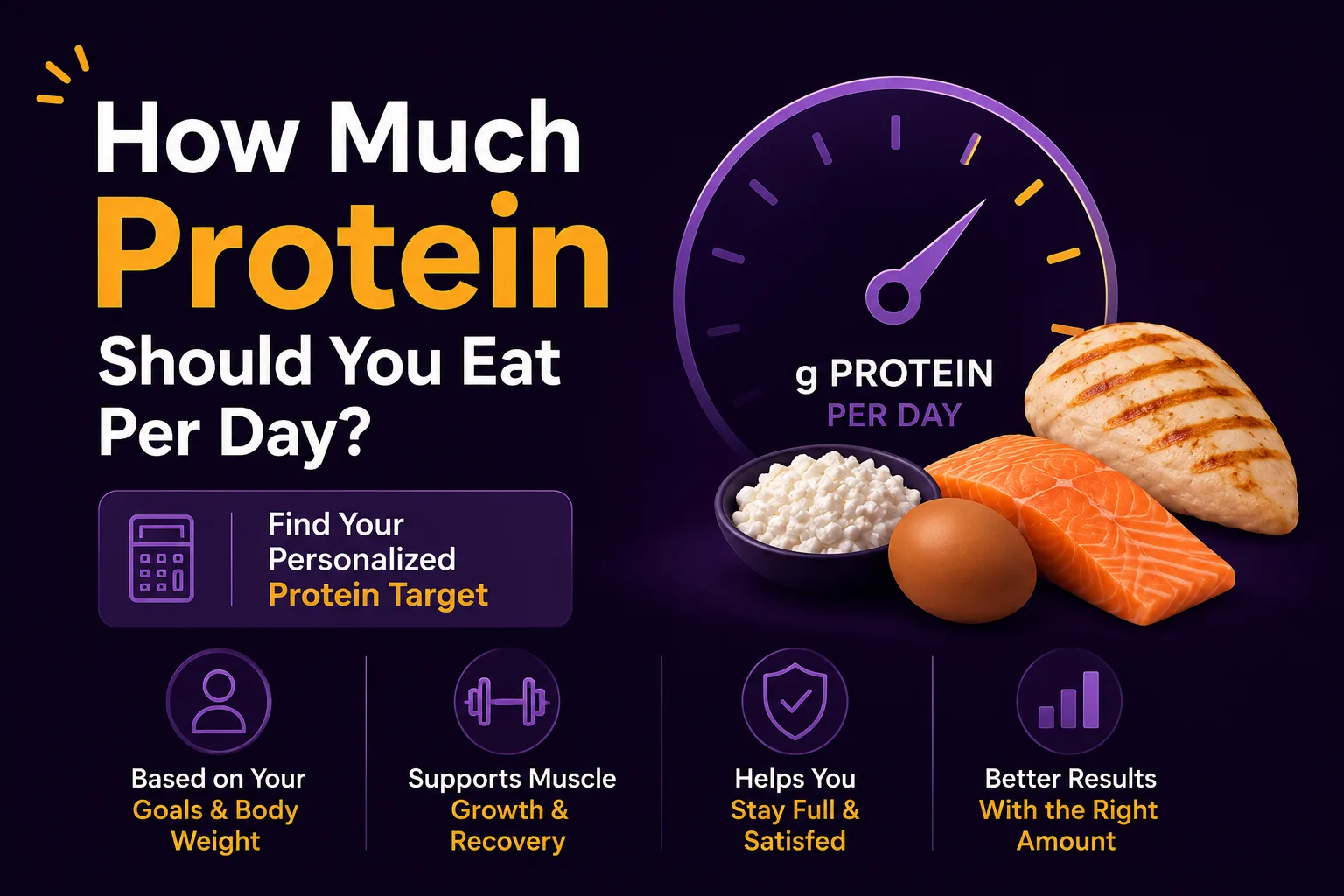
How Much Protein Should You Eat Per Day?
How much protein should you eat per day is one of the most common questions in weight loss, fitness, and macro tracking. The confusing part is that the answer changes depending on your body size, activity level, age, and goal.
This article explains the baseline protein recommendation, when you may need more, how protein supports weight loss and muscle gain, and how to hit protein goals without turning every meal into a calculation.
SlimAI Calorie Tracker helps users work toward weight management with AI Calorie Tracker, Macro Tracker, Flexible Food Logging, Custom Calorie Goals, and Progress, Streaks & Back-Date Logging.
What is daily protein intake?
Daily protein intake is the amount of protein you eat across a full day from foods such as meat, fish, eggs, dairy, beans, lentils, tofu, nuts, seeds, and other protein-containing meals. Protein is a macronutrient that helps the body build and repair cells, tissues, and muscles, and the Academy of Nutrition and Dietetics describes it as the essential macronutrient responsible for building tissues in the body, including muscle.
SlimAI Calorie Tracker connects Macro Tracker with Flexible Food Logging, helping users review protein intake alongside calories, carbohydrates, fats, and meal patterns.
Why does protein intake matter?
Protein matters because it supports basic body function, tissue repair, muscle maintenance, and meal satisfaction. MedlinePlus explains that you need protein in your diet to help your body repair cells and make new ones, and describes protein as important for growth and development in children, teenagers and pregnant women.
Protein is not only relevant for people who lift weights. It matters if you want steadier meals, better macro awareness, or a more structured weight-management routine.
The challenge is that “eat more protein” is not specific enough. You need a practical target, then a way to see whether your meals actually support it.
That is where macro tracking becomes useful. You can stop guessing whether your day had enough protein and start reviewing your actual pattern.
What do most people get wrong about protein?
They think the baseline is the best target for every goal
The 0.8 grams per kilogram baseline is often discussed as a minimum for healthy adults, and it was derived from nitrogen balance data as the intake that covers 97.5% of the healthy adult population. It does not automatically represent the best target for training, satiety, fat loss, or muscle gain.
Your goal changes the context.
They expect protein alone to cause weight loss
Protein can support fullness and meal structure, but it does not override calorie intake. Weight loss still depends on overall energy balance over time.
Protein helps the plan feel more manageable. It does not replace the plan.
They only think about protein at dinner
Many people eat very little protein earlier in the day, then try to fix the number at night. Spreading protein across meals can make your day easier to manage.
A steady pattern usually works better than one very high-protein meal.
What actually works for daily protein goals?
Start with the baseline, then adjust based on your goal.
For healthy adults, the commonly cited Recommended Dietary Allowance is 0.8 grams of protein per kilogram of body weight per day. That figure comes from a meta-analysis of nitrogen balance studies in The American Journal of Clinical Nutrition, which put the estimated average requirement at 0.65 g/kg/day and the RDA at 0.83 grams of good-quality protein per kilogram per day. MedlinePlus frames the same baseline as a share of intake, recommending 10% to 35% of your total calorie needs.
If you train regularly, protein needs may be higher. The International Society of Sports Nutrition position stand states that an overall daily intake of 1.4–2.0 grams per kilogram per day is sufficient for most exercising individuals, and adds that higher intakes of 2.3–3.1 g/kg/day may be needed to maximise retention of lean body mass in resistance-trained people during hypocaloric periods.
For weight loss, protein may help because it can support satiety and lean-mass retention. A review in The American Journal of Clinical Nutrition reports greater weight loss, greater fat mass loss and better preservation of lean mass on higher-protein energy-restriction diets than on lower-protein ones, alongside a modest satiety effect of greater perceived fullness after higher-protein meals. It suggests roughly 1.2 to 1.6 g/kg/day, with about 25–30 g of protein per meal.
A practical starting sequence is: know your body weight, set a realistic calorie goal, track protein for a few days, then adjust based on hunger, training, and consistency.
How SlimAI Calorie Tracker helps with protein tracking
SlimAI Calorie Tracker helps with protein tracking by showing protein inside Macro Tracker instead of making you calculate meals from memory. If your goal is weight loss, muscle gain, or better meal balance, SlimAI can help you compare protein intake with calories, carbohydrates, fats, and progress patterns.
Flexible Food Logging supports protein tracking through Type to Add, Voice to Log, Camera Scan, Gallery Upload, Food Database Search, Recent Foods, Saved Foods, Diet Plan Logging, Meal Suggestions, and Back-Date Logging.
AI calorie estimates can vary because of portion size, ingredients, sauces, cooking methods, and serving size. SlimAI reduces this friction with Ingredient Editing and Serving Size Guidance, helping users adjust entries closer to what they actually ate.
Explore the most relevant feature: /features/macro-tracker
How can you hit your protein goals without overcomplicating meals?
Start with a baseline protein target
Use 0.8 grams per kilogram as a general adult baseline, then adjust for your goal, activity, and health context. If you train regularly or want body-composition support, a higher target may make more sense.
Add protein to your first meal
Breakfast often sets the tone for the day. Eggs, Greek yogurt, cottage cheese, tofu, beans, lentils, or a protein-rich smoothie can make the daily target easier to reach.
Build lunch and dinner around a protein source
Choose the protein first, then add carbohydrates, fats, and vegetables around it. This keeps protein from becoming an afterthought.
Track protein for one week before changing everything
A few days of food logs can show whether protein is actually low. Do not overhaul your meals before you understand your normal pattern.
Use macro tracking as feedback, not pressure
Protein tracking should help you adjust meals, not make eating stressful. If the number feels overwhelming, track calories and protein first before watching every macro closely.
Conclusion: How Much Protein Should You Eat Per Day?
How much protein you should eat per day depends on your body size, activity level, age, and goal. The common baseline for healthy adults is 0.8 grams per kilogram of body weight per day, but people focused on weight loss, training, or muscle gain may benefit from a higher intake.
Protein can support fullness, muscle maintenance, tissue repair, and meal structure. Still, it is not a shortcut that replaces calorie awareness, training, sleep, or a balanced routine.
SlimAI Calorie Tracker can support protein tracking with Macro Tracker, AI Calorie Tracker, Flexible Food Logging, Custom Calorie Goals, Ingredient Editing, Serving Size Guidance, and Progress, Streaks & Back-Date Logging. The practical goal is not to chase the highest protein number. It is to build a protein target you can repeat across real meals.