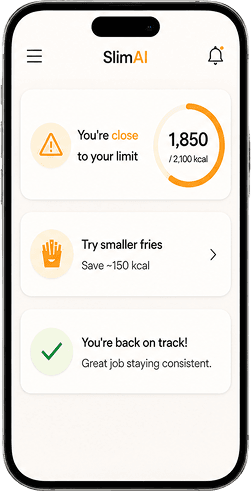




Ranked by what each app is genuinely best at, as of July 2026. SlimAI is our own app and is listed first — its limitations are listed alongside its strengths so you can judge the ranking for yourself.
SlimAI Calorie Tracker
Our appBest for: Photo logging with a real correction path, plus body composition
SlimAI treats an AI estimate as a first draft rather than an answer. Every scan opens as an editable list of ingredients with their weights: remove what is not on the plate, add what the model missed from a searchable ingredient database, adjust the serving with a stepper that recalculates live, pick from Similar Foods, or open a Fix Results screen and simply type what the dish actually was. On top of that it is the first AI calorie tracker with a built-in AI body fat calculator.
Strengths
- Ingredient-level editing on every scan, before anything is logged
- Similar Foods and a Fix Results screen for when the model reads the plate wrong
- Six input methods — photo, voice, text, barcode, printed nutrition label, database search
- AI Body Assessment: body fat percentage, fat and lean mass, regional distribution, from photos or tape measurements
- Fasting, water, steps, workouts, weight and progress in the same subscription tier
- An in-app Sources & References screen disclosing the basis for calorie, portion, and burn estimates
Limitations
- Calorie and portion figures remain estimates, not measurements — as they are in every app of this type
- No diary import from another tracker
- Body Assessment is a fitness estimate for ages 18+, not a clinical measurement
See what SlimAI does →MyFitnessPal
Best for: The largest food database to fall back on
If your frustration with AI scanning is that obscure packaged or restaurant items come back wrong, the answer may be database size rather than a better model. MyFitnessPal remains the largest and has photo logging alongside search.
Strengths
- Very large food and restaurant database
- Deep third-party integration ecosystem
- Long history of diary data if you already have an account
Limitations
- Search-driven logging is slower than photo-first workflows
- Several capabilities sit behind the Premium tier
- No body composition estimation
Compare SlimAI with MyFitnessPal point by point →Cronometer
Best for: Trusting the numbers behind the estimate
The opposite philosophy to photo-first: curated, lab-verified entries instead of a model guessing at a plate. Slower to log, but if your objection to AI scanning is accuracy on principle, this is the honest alternative.
Strengths
- Verified rather than crowd-sourced food data
- Deep micronutrient tracking
- Well suited to medically-motivated tracking
Limitations
- No meaningful AI photo logging
- Detail-heavy entry takes longer per meal
Lose It!
Best for: A simpler surface with photo logging attached
Calorie budgeting kept deliberately plain, with photo-based logging available. A good fit if Cal AI felt right in approach but you want a longer-established database behind it.
Strengths
- Low learning curve
- Established food database
- Photo logging alongside search
Limitations
- Shallower macro and nutrition detail
- No body composition estimation
Compare SlimAI with Lose It! point by point →YAZIO
Best for: Being told what to eat, not only recording it
Tracking paired with structured meal plans, recipes, and a fasting tracker. Choose it if the gap you feel is guidance rather than logging speed.
Strengths
- Meal plans and recipe library built in
- Integrated intermittent fasting
- Strong European food coverage
Limitations
- AI logging is not the centre of the product
- No body fat estimation
Compare SlimAI with YAZIO point by point →Lifesum
Best for: Food quality ratings alongside the calorie count
Rates what you log rather than only counting it, organised around a chosen eating style. Useful if you want the app to have an opinion about the meal.
Strengths
- Diet-specific plans and recipes
- Quality ratings on logged food
- Approachable interface
Limitations
- Less granular macro control
- No body composition measurement