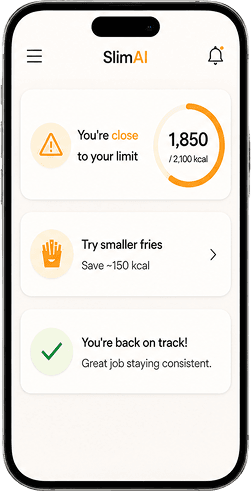
Ranked by what each app is genuinely best at, as of July 2026. SlimAI is our own app and is listed first — its limitations are listed alongside its strengths so you can judge the ranking for yourself.
SlimAI Calorie Tracker
Our appBest for: Fast AI logging, a weekly coach that reads your log, and a body fat estimate
SlimAI is built around the assumption that the logging step is what kills the habit. You photograph the plate, speak the meal, type it, scan a barcode, scan a printed nutrition label, or search the database — and whatever the AI returns opens as an editable list of ingredients and weights before anything saves. AI Coach then reads the week you logged and answers where your weight is heading, what drove it, and the one thing worth doing next, with a written report every Monday. It is also the first AI calorie tracker with a built-in AI body fat calculator: AI Body Assessment estimates body fat percentage, fat mass, lean mass, and regional fat distribution from two photos, or from tape measurements with no photos at all.
Strengths
- Six logging methods, including photo, voice, and free text — no database search required
- Every AI result is editable at the ingredient level before it saves, with a Fix Results screen when the scan reads the plate wrong
- AI Coach: a smoothed weight trajectory, the meal and weekdays that drove your calories, a weekly score, and one action per insight — free, and rule-based rather than a chatbot
- A written weekly report every Monday, plus plateau detection that proposes one confirmable, reversible change when your weight trend goes flat
- AI Body Assessment: body fat percentage, fat and lean mass, and regional distribution, from photos or tape measurements
- Calories, macros, fasting, water, steps, workouts, and progress in one subscription tier rather than several apps
- Per-meal calorie ranges that show which meals still have room, instead of only a daily total
- Seven languages: English, French, German, Italian, Spanish, Dutch, and Arabic
Limitations
- Does not import diary history from MyFitnessPal — your weight trend, streaks, and insights start from your first log
- A 50K+ curated database rather than a multi-million-row one — deliberate, and covered by barcode, label scan, photo and voice, but a large catalogue still helps for obscure restaurant menu items
- Body Assessment is a fitness estimate for ages 18+, not a medical or clinical body composition measurement
Cronometer
Best for: Verified micronutrient data
Cronometer built its reputation on data quality: entries drawn from curated, lab-verified sources rather than crowd-sourced submissions, and tracking that goes well past calories and the three macros into vitamins and minerals. If you are switching because you did not trust MyFitnessPal database entries, this is the direct answer.
Strengths
- Curated, verified food entries rather than user-submitted ones
- Extensive micronutrient tracking — vitamins, minerals, amino acids
- Well suited to medically-motivated or clinically-supervised tracking
Limitations
- Logging is search-driven and detail-heavy, so it is slower than photo-first apps
- The depth is wasted if all you want is a daily calorie number
Lose It!
Best for: A simple calorie budget with no extra concepts
Lose It! keeps the model deliberately narrow: set a calorie budget, log against it, watch the number go down. For someone who found MyFitnessPal cluttered rather than slow, the simpler surface is the whole appeal.
Strengths
- Straightforward calorie budgeting with a low learning curve
- Photo-based logging available alongside the usual search
- Long-established food database
Limitations
- Less depth on macros and nutrition detail than Cronometer or SlimAI
- No body composition estimation
YAZIO
Best for: Meal plans and fasting in one place
YAZIO pairs calorie tracking with structured meal plans and a fasting tracker, and has a strong European recipe library. If your reason for leaving is that you want to be told what to eat rather than only record it, this is a reasonable landing spot.
Strengths
- Recipe and meal-plan library built into the tracker
- Built-in intermittent fasting support
- Strong non-US food coverage
Limitations
- AI logging is less central than in photo-first apps
- No body fat estimation
Cal AI
Best for: Photo-first logging above everything else
Cal AI is built almost entirely around pointing a camera at a plate. If the single thing you want from a MyFitnessPal replacement is to stop typing, it delivers that narrowly and well.
Strengths
- Fast photo-based calorie estimation
- Minimal, focused interface
Limitations
- Narrower feature set — fasting, water, workouts and steps are not the focus
- Fewer fallbacks when a photo estimate is wrong
Lifesum
Best for: Diet-led tracking with food quality ratings
Lifesum frames tracking around a chosen eating style — keto, high protein, Mediterranean and similar — and rates the quality of what you log rather than only counting it. Good for someone who wants nutrition guidance attached to the number.
Strengths
- Diet-specific plans and recipes
- Food quality ratings alongside calorie counts
- Polished, approachable interface
Limitations
- Less granular macro control than a dedicated macro tracker
- No body composition measurement
MacroFactor
Best for: Athletes who want an adaptive calorie target
MacroFactor calculates your energy expenditure from your own logged intake and weight trend, then adjusts your targets each week. It is the most quantitative option here and is aimed squarely at people who already understand macro periodisation. The distinction worth knowing: MacroFactor recalculates continuously, while SlimAI changes your target only when it detects a plateau and only after you confirm the change.
Strengths
- Adaptive expenditure calculation from your own data
- Weekly target adjustments without manual recalculation
- Strong macro-first design for coached training
Limitations
- Assumes real familiarity with macro tracking
- Logging is manual rather than AI-driven