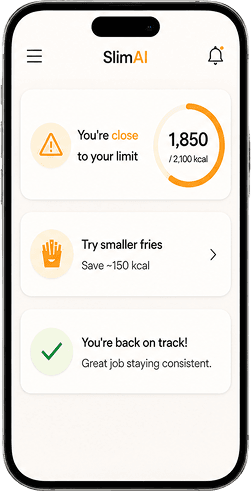
Ranked by what each app is genuinely best at, as of August 2026. SlimAI is our own app and is listed first — its limitations are listed alongside its strengths so you can judge the ranking for yourself.
SlimAI Calorie Tracker
Our appBest for: Fast AI logging, mealtime guidance and a body composition estimate
SlimAI answers all three of the usual complaints and concedes the fourth. Logging happens by photo, voice, free text, barcode, printed nutrition label or database search, with every AI result opening as an editable ingredient list with weights before anything saves. Diet plans with one-tap swaps replace the blank page Cronometer leaves at dinnertime, and per-meal calorie budgets show which meals still have room. AI Body Assessment adds the measure weight cannot give you — body fat percentage, fat mass, lean mass and regional distribution. What it does not do is match Cronometer on vitamins and minerals, and that is a real loss rather than a rounding error.
Strengths
- Six logging methods — photo, voice, free text, barcode, printed nutrition label and database search — with ingredient-level editing before anything saves
- Per-meal calorie budgets that show which meals still have room, rather than only a daily total
- AI Body Assessment estimates body fat percentage, fat mass, lean mass and regional distribution from two guided photos, or from tape measurements with no photos at all
- Diet plans with one-tap swaps, shaped by preferred diet, favourite cuisine and region — the guidance layer Cronometer deliberately does not attempt
- Six fasting plans — 14:10, 16:8, 20:4, 22:2 OMAD, 6:1, 5:2 — plus water tracking and steps and workouts synced from Apple Health or Health Connect
- AI Coach reads the week you logged into a trajectory, a cause and one action, with a written Weekly Report every Monday — deterministic rules over your own data, so the same week always produces the same output, not a generative chatbot
- Health Patterns and Smart Food Swaps compare fasting days against your own non-fasting days, training against rest, and lean mass across two body scans
- Adaptive calorie goals with plateau detection, which needs roughly 14 days of a flat trend plus solid logging before proposing one change you must approve
- One tier: SlimAI Pro at $7.99/month or $29.99/year, after a 3-day free trial
Limitations
- Micronutrient coverage is far shallower than Cronometer — percent-of-daily-value rows for sugar, saturated and unsaturated fat, cholesterol, sodium and potassium, not full vitamin, mineral and amino acid tracking
- A 50K+ curated food items database rather than a giant catalogue, which is weaker for obscure regional grocery brands — barcode and label scanning cover most packaged gaps, but not all of them
- Photo estimates need reviewing for mixed and homemade dishes, where a model reads a covered ingredient less reliably than you can state it
- No import of another app diary history, and AI Body Assessment is a fitness estimate for ages 18+, not a clinical body composition measurement
MacroFactor
Best for: Adaptive macro coaching for lifters
MacroFactor calculates your energy expenditure from your own logged intake and weight trend, then moves your macro targets each week without you recalculating anything. For a Cronometer user who was tracking to a number rather than to a specific nutrient, it is the most direct upgrade in guidance available, and it keeps the quantitative register that made Cronometer appealing in the first place.
Strengths
- Adaptive expenditure calculation derived from your own intake and weight data
- Weekly macro target adjustments with no manual recalculation
- Macro-first design that suits structured training blocks and coached lifters
Limitations
- Logging is manual rather than AI-driven, so the daily time cost stays close to what you already have
- Assumes real familiarity with macro tracking and periodisation
- Micronutrient depth is not the point, and no body composition estimate is offered
MyFitnessPal
Best for: Catalogue size and third-party integrations
If the specific thing failing you is that the food you eat is not in the database — obscure restaurant items, regional supermarket lines — catalogue size is the direct fix, and the integration ecosystem is the broadest here. Be clear about the trade you are making: entries are heavily crowd-sourced, so you are giving up precisely the data provenance you chose Cronometer for.
Strengths
- The largest food and restaurant catalogue of any tracker on this list
- Wide device, wearable and third-party app integrations
- Macro tracking with a long-established logging workflow people already know
Limitations
- Entries are heavily crowd-sourced, so provenance is a clear step down from verified data
- Search-driven logging is still slow, so the main Cronometer complaint is not solved
- No body composition estimation
Lifesum
Best for: Diet-led plans with food quality ratings
The most direct answer to the no-meal-plans complaint. You choose an eating style, follow plans and recipes built for it, and get a quality rating on what you log rather than only a count. It is the opposite of Cronometer in temperament: guidance first, data second.
Strengths
- Diet-specific plans and recipes for keto, high protein, Mediterranean and similar
- Food quality ratings alongside the calorie figure
- Approachable interface with very little to configure before you start
Limitations
- Less granular macro control than a macro-first tracker
- Micronutrient tracking is shallow by comparison
- No body composition measurement
Lose It!
Best for: Stripping back to a simple calorie budget
If Cronometer felt like far more instrumentation than your goal required, this removes almost all of it and leaves a calorie number and a way to log against it. A deliberate downgrade in depth, chosen on purpose by people whose reason for tracking was never nutritional precision.
Strengths
- Very low learning curve with a single clear daily budget
- Long-established food database
- Photo-based logging available alongside the usual search
Limitations
- Nutrition depth well below Cronometer, which is the entire point of choosing it
- No meal plans of consequence
- Weight-only progress, so the measurement gap is unchanged
Cal AI
Best for: Photo-only logging speed
The narrowest option here and the furthest from Cronometer in philosophy. Worth considering only if logging time is your single complaint and you accept giving up nutritional depth, fasting, water and planning to fix it.
Strengths
- Fast photo-based calorie estimation
- Minimal interface with almost nothing to configure
Limitations
- Narrow feature set — fasting, water, steps and workouts are not the focus
- Fewer correction paths when a photo estimate reads the plate wrong
- Nutritional depth is the direct opposite of what Cronometer offers