Ranked by what each app is genuinely best at, as of July 2026. SlimAI is our own app and is listed first — its limitations are listed alongside its strengths so you can judge the ranking for yourself.
SlimAI Calorie Tracker
Our appBest for: Daily awareness and body composition at under $3 a month
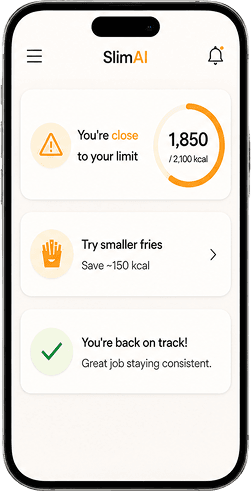
SlimAI does the part of a weight-loss programme that has to happen every day: knowing what you ate and what it cost you, in seconds rather than minutes. Log by photo, voice, text, barcode, nutrition label, or search, and edit ingredients and weights before saving. Personalized setup turns your goal, pace, target weight, body type, activity level, preferred diet, and cuisine into a daily calorie goal with gram-level macro targets. AI Body Assessment then estimates body fat percentage, fat mass, lean mass, and regional distribution — so progress is not hostage to the scale.
Strengths
- AI Body Assessment measures body composition, not only weight — the gap Noom leaves
- Six logging methods with ingredient-level editing before anything saves
- AI Coach does the calculating half of coaching: a smoothed weight trajectory, the meal and weekdays that drove your calories, a weekly score, and one action — plus a free written report every Monday
- Personalized daily calorie and macro targets from a short guided setup
- Fasting, water, steps, workouts, streaks and progress in one tier
- Server-scheduled reminders that arrive even when the app has been closed for days
- Priced as an app, not a programme: $29.99/year — under $3 a month
Limitations
- AI Coach is rule-based software, not a person — no accountability, no negotiation, and no one who notices when you go quiet
- No human coaching and no daily psychology curriculum — if that is what keeps you consistent, this is not a replacement
- No diary import from Noom or any other app
- Body Assessment is a fitness estimate for ages 18+, not a medical or clinical measurement
MyFitnessPal
Best for: The largest food database and the widest integrations
The default calorie tracker, and the most conservative switch from Noom. No curriculum, no coaching, a very large database, and an ecosystem of connected apps and devices.
Strengths
- Largest food and restaurant database
- Extensive third-party integrations
- Familiar to most people who have tracked before
Limitations
- Search-driven logging is slow enough that many people lapse
- Several features sit behind Premium
- No body composition measurement
Lifesum
Best for: Structure and guidance without a coaching price
The closest thing here to Noom in spirit: a chosen eating style, plans and recipes to follow, and quality ratings on the food you log — but as an app subscription rather than a programme.
Strengths
- Diet-led plans with recipes
- Food quality ratings, not only calorie counts
- Polished and approachable
Limitations
- No human coaching
- Less granular macro control
- No body composition tracking
Lose It!
Best for: The simplest possible calorie budget
A calorie number and a way to log against it, with very little else. If Noom felt like too much apparatus around a simple idea, this is the minimal version.
Strengths
- Very low learning curve
- Established food database
- Photo logging alongside search
Limitations
- Little guidance of any kind
- Shallow nutrition detail
- Weight-only progress
YAZIO
Best for: Meal plans plus fasting in one subscription
Tracking with structured meal plans, a recipe library, and built-in intermittent fasting. A good fit if what you valued in Noom was being told what to do at mealtimes.
Strengths
- Meal plans and recipes included
- Integrated fasting tracker
- Strong European food coverage
Limitations
- No coaching
- AI logging is not the focus
- No body fat estimation
Cronometer
Best for: Medically-motivated tracking with verified data
If you left Noom because you need real nutritional precision — a clinical reason, a deficiency, a supervised plan — this is the app with the data quality to support it.
Strengths
- Curated, verified food entries
- Deep micronutrient tracking
- Suited to supervised or clinical use
Limitations
- Slow, detail-heavy logging
- No behavioural support
- No body fat estimation