



Ranked by what each app is genuinely best at, as of August 2026. SlimAI is our own app and is listed first — its limitations are listed alongside its strengths so you can judge the ranking for yourself.
SlimAI Calorie Tracker
Our appBest for: Adaptive targets, six ways to log, and body composition in one tier
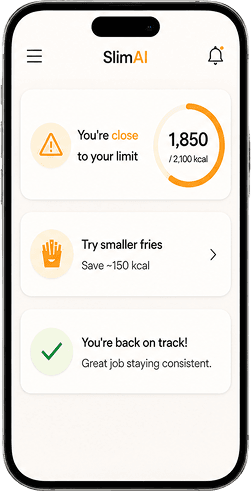
SlimAI keeps the parts of Lifesum that work — a preferred diet that actually shapes what you see, guidance rather than a bare number — and changes the parts people leave over. Preferred diet, favourite cuisine and region are setup inputs that shape your calorie and macro targets, not just a label on your profile. Logging happens by photo, voice, free text, barcode, printed nutrition label or database search, and every AI result opens as an editable ingredient list before it saves. Calories, macros, fasting, water, steps, workouts, progress and AI Body Assessment sit in one tier, SlimAI Pro, at $7.99/month or $29.99/year after a 3-day free trial.
Strengths
- Six logging methods — photo, voice, free text, barcode, printed nutrition label, database search — with ingredient-level editing before anything saves
- Preferred diet shapes targets and suggestions, with one-tap swaps across keto, Mediterranean, paleo, vegan and vegetarian eating rather than a fixed weekly script
- Adaptive calorie goals with plateau detection: a flat trend across roughly 14 days plus solid logging produces one proposed change you must approve, with inline undo
- AI Body Assessment estimates body fat percentage, fat mass, lean mass and regional distribution from two guided photos, with a tape-measure mode requiring no photos
- Six intermittent fasting plans — 14:10, 16:8, 20:4, 22:2 OMAD, 6:1, 5:2 — plus water tracking and steps and workouts via Apple Health or Health Connect
- AI Coach is deterministic: fixed rules over your own logged data, so the same week always produces the same output, with a written Weekly Report and Health Patterns
- Smart Food Swaps names a specific lighter dish rather than only rating the one you logged, and per-meal calorie budgets show what still fits before you eat
Limitations
- A database of 50K+ curated food items rather than a giant catalogue — obscure regional grocery brands are more likely to need manual entry than in a database-first tracker
- No scripted multi-week programme: SlimAI gives targets, per-meal budgets and swaps, so if a laid-out week is what you want, this is the wrong shape
- Photo estimates need reviewing for mixed and homemade dishes — the ingredient list is editable for exactly that reason, but it is a step, not a guarantee
- A smaller recipe library than a plan-led app, and no import of another tracker diary
- AI Coach is rule-based software, not a person, and AI Body Assessment is a fitness estimate for ages 18+, not a medical diagnosis
See the full SlimAI vs Lifesum breakdown →YAZIO
Best for: Recipe-led plans with strong European food coverage
The closest like-for-like replacement if what you valued in Lifesum was the plan-and-recipe model. Structured meal plans, a large recipe library, integrated intermittent fasting, and food coverage that holds up well across European markets.
Strengths
- Structured meal plans with a substantial recipe library
- Integrated intermittent fasting alongside calorie tracking
- Strong European and packaged-food coverage
Limitations
- Search-driven logging, so the entry burden is much the same as Lifesum
- Plans are scripted rather than adaptive
- No body composition measurement
Compare SlimAI with YAZIO point by point →MyFitnessPal
Best for: Database size and breadth of integrations
If the specific thing failing you in Lifesum is finding the food you eat, sheer catalogue size is the most direct fix available, along with the widest range of connected devices and apps. What you give up is guidance: this is a tracker rather than a programme.
Strengths
- The largest food and restaurant database in the category
- Extensive third-party device and app integrations
- Familiar to most people who have tracked calories before
Limitations
- Search-driven logging is slow enough that many people lapse
- Crowd-sourced entries vary in quality and need checking
- Several features sit behind its subscription tier, and there is no body composition measurement
Compare SlimAI with MyFitnessPal point by point →Cronometer
Best for: Verified data and micronutrient depth
A different priority altogether: data quality ahead of guidance. Choose it if you need to trust the numbers for a clinical, supervised or deficiency-related reason and are willing to spend longer on each entry to get them.
Strengths
- Curated, verified food entries rather than crowd-sourced ones
- Deep vitamin and mineral tracking well beyond macros
- Well suited to medically-motivated or supervised tracking
Limitations
- Slow, detail-heavy logging
- No diet plans, recipes or food quality ratings of the kind Lifesum is built around
- No body fat estimation
Compare SlimAI with Cronometer point by point →Lose It!
Best for: Stripping back to a simple calorie budget
If Lifesum felt like more structure than you wanted, this removes nearly all of it and leaves a calorie number and a way to log against it. The lowest learning curve on this list, and the least guidance.
Strengths
- Very low learning curve
- Established food database
- Photo logging available alongside search
Limitations
- No diet plans and no food quality ratings
- Shallow nutrition detail beyond calories and basic macros
- Weight-only progress, with no fasting tracker
Compare SlimAI with Lose It! point by point →Cal AI
Best for: Photo logging as the entire product
The narrowest option here. Worth considering only if logging speed is your single complaint and you are prepared to give up diet plans, fasting, water tracking and recipes to get it.
Strengths
- Fast photo-based calorie estimation
- Minimal interface with almost nothing to learn
Limitations
- No diet plans, fasting or water tracking of consequence
- Fewer correction paths when an estimate is wrong
- No body composition measurement
Compare SlimAI with Cal AI point by point →