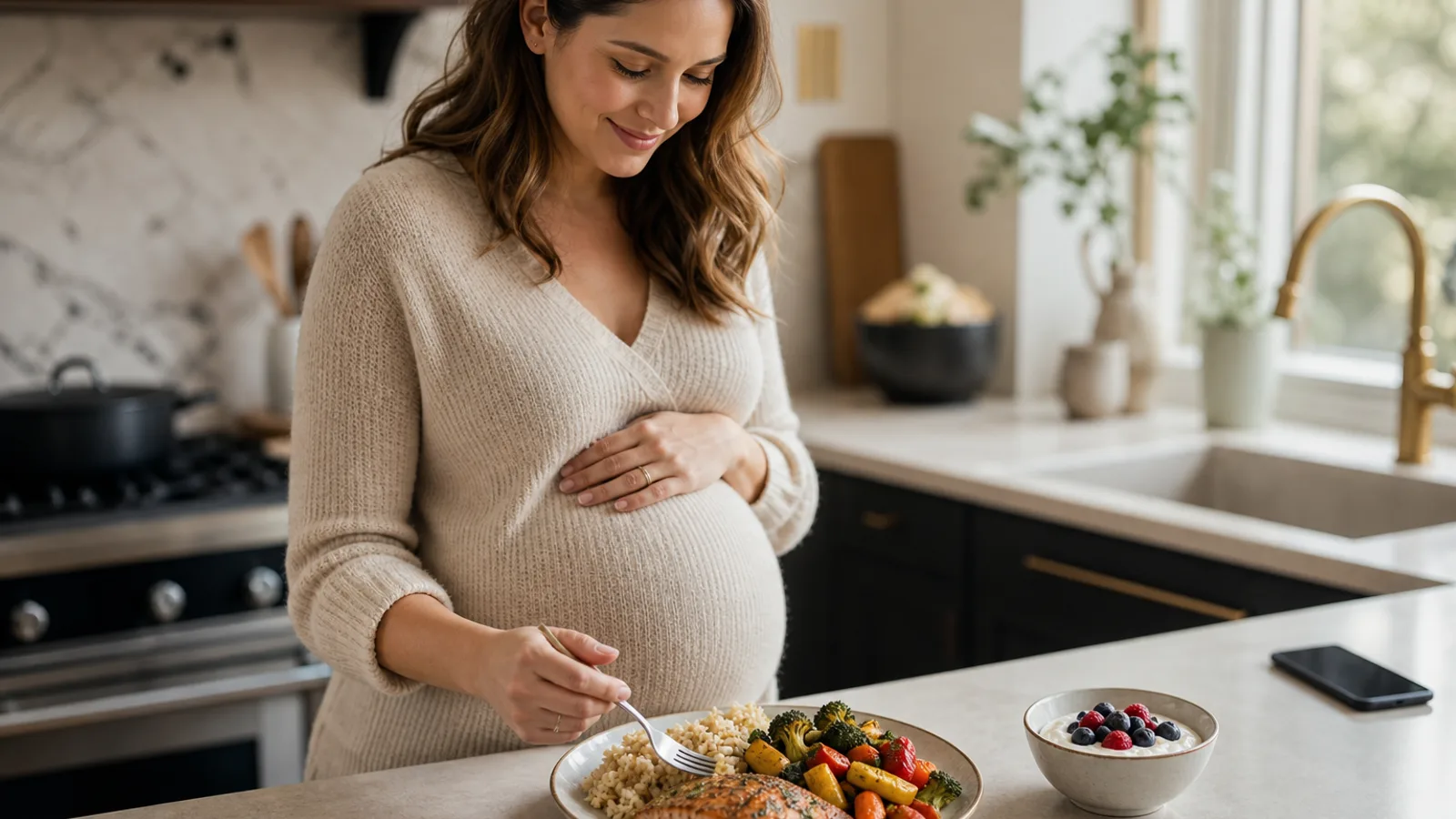
A postpartum belly is normal: the uterus takes about six weeks to shrink back, the abdominal muscles are still separated in around 60% of women at six weeks (diastasis recti), and skin and fat stores recover at their own pace. It is not a willpower problem. Gentle core rehab, time and slow fat loss help; crunches and crash diets do not.
Weeks or even months after giving birth, many women look down and ask the same question: why do I still look pregnant? The short answer is that a postpartum belly is a normal part of recovery, not a sign you are doing something wrong. Your uterus, abdominal muscles, skin and fat stores all change at different speeds.
This guide explains what causes a postpartum belly and "mommy pooch," how to check for diastasis recti, and what research says actually helps. It is general information. A doctor, midwife or pelvic floor physiotherapist should assess your own recovery.
Why you still have a belly after birth
Several things happen at once in the months after delivery, and each has its own timeline.
| What is changing |
Typical timeline |
What it looks like |
| Uterus shrinking back |
About 6 weeks |
A firm, rounded belly that slowly gets smaller |
| Fluid and swelling clearing |
First 1–2 weeks |
Puffiness in the belly, legs and feet |
| Abdominal muscles regaining tone |
Months |
A soft belly that pushes out when you sit up |
| Diastasis recti closing |
Months to a year or more |
A ridge or dome down the middle of your belly |
| Pregnancy fat stores |
Months, often longer |
Softness on the lower belly, hips and thighs |
| Stretched skin |
Varies, sometimes permanent |
Loose or crepey skin that does not "snap back" |
Most women lose around 10 to 13 lb at birth, from the baby, placenta and fluid. The rest comes off slowly. That gap between what the scale says and how your belly looks is where most frustration comes from.
Postpartum weight retention differs by background
Research shows that how much weight women keep after pregnancy is not the same for everyone. In a 2016 study of 642 women in Oslo, women of South Asian, Middle Eastern and African origin were significantly more likely to have high weight retention at 14 weeks postpartum than Western European women. Genetics, diet, activity patterns and how families support new mothers all likely play a part.
If your recovery feels slower than the influencers you follow, that comparison is not fair to you. Your body, your background and your circumstances are different.
Stop guessing what you ate.
Snap a photo and SlimAI does the rest — 10K+ downloads on iOS and Android.
3-day free trial · Cancel anytime · No card charged during trial
What is diastasis recti?
Diastasis recti, or ab separation, is when the two sides of your rectus abdominis (the "six-pack" muscle) pull apart along the midline during pregnancy. The connective tissue between them, the linea alba, stretches and thins to make room for your baby.
It is extremely common. A study of 300 first-time mothers in Norway, published in the British Journal of Sports Medicine in 2016, found diastasis recti in:
- 60% of women at 6 weeks postpartum
- 45% at 6 months
- 33% at 12 months
Most cases were mild. The same study found no difference in lower back and pelvic pain at 12 months between women with and without a gap.
The diastasis recti self-check
You can do a simple check at home. It is a screen, not a diagnosis.
- Lie on your back with your knees bent and feet flat on the floor.
- Place your fingertips across your midline at your belly button, fingers pointing toward your feet.
- Gently lift your head and shoulders off the floor, as if starting a small crunch.
- Feel for a gap between the two muscle edges. Repeat a few inches above and below your belly button.
- Notice the width (in finger widths) and how deep your fingers sink.
A gap wider than about two fingers, or a ridge or dome that pops up along the middle when you lift, suggests diastasis recti. A pelvic floor or women's health physiotherapist can measure it properly and check your deep core and pelvic floor at the same time.
Is it a mommy pooch or fat?
"Mommy pooch" usually means the lower belly bulge that stays after most of the baby weight is gone. In practice it is rarely one thing. It is often a mix of:
- Ab separation, which lets the belly push forward
- Weak deep core muscles (the transverse abdominis), which normally act like a corset
- Stretched skin that has less elasticity than before
- Stored fat, which the body tends to keep on the lower belly and hips
That is why some women lose all their pregnancy weight and still have a pooch, while others carry extra weight with a fairly flat middle. Weight loss helps with the fat part. Core rehab helps with the muscle part. Neither fixes skin that has stretched a lot.
How to get rid of a mommy pooch: what helps
1. Get your core and pelvic floor assessed
This is the most useful single step. A pelvic floor physiotherapist can tell you how wide and deep any gap is, whether your pelvic floor is working well, and which exercises suit your stage. In many countries you can ask your doctor or midwife for a referral at your postnatal check.
2. Rebuild the deep core gradually
Physiotherapists commonly start with breathing, gentle deep-core activation and pelvic floor work, then progress to harder movements as your body copes. Exercise plans should be personal, so follow the program your physiotherapist gives you rather than a generic online routine.
3. Lose fat slowly, if you want to
Fat loss after pregnancy works the same way as any other time: a modest calorie deficit over time. A few rules make it safer:
- Wait until your body has recovered and you have the all-clear from your doctor or midwife, usually after your postnatal check.
- Aim for about 1 lb (0.5 kg) a week at most. Faster loss is harder to sustain and, if you are breastfeeding, can affect supply.
- Eat enough protein to support healing and muscle. Our guide to how much protein you need per day explains the basics.
- If you are breastfeeding, factor in the 450–500 calories a day that making milk uses. See how many calories breastfeeding burns.
What you eat in the first weeks also matters. Our postpartum diet guide covers recovery foods, including traditional 40-day confinement diets.
4. Walk, then build up
Walking is gentle, helps mood and energy, and fits around a newborn. Most women can start short walks soon after birth and build up as they feel able. Ask your provider when to return to running, lifting and high-impact exercise.
5. Be patient with sleep and stress
Broken sleep raises hunger and makes fat loss harder. Short naps, help with night feeds where possible, and simple meals you can eat one-handed all count.
If you had a C-section
A cesarean adds a healing incision and scar to everything above. Some women notice an overhang or "shelf" above the scar that behaves differently from the rest of the belly. We cover that in detail in C-section shelf: why it happens and what helps.
When to see a doctor
Book an appointment if you notice:
- A bulge at your belly button or along the midline that pokes out when you cough, strain or lift, which can be a hernia
- Pain in your belly, back or pelvis that is getting worse
- Bladder or bowel leaks, or a heavy, dragging feeling in your pelvis
- A gap that is not improving after several months of rehab
How SlimAI can help
SlimAI is a general calorie and macro tracker, not a postpartum program, and it does not give exercise or medical advice. Once your provider says it is OK to work on weight loss, it can make tracking easier when your hands are full:
- Snap a photo or say what you ate. The AI estimates calories, protein, carbs and fat, and you can edit servings and ingredients before saving.
- Choose your goal. Pick "Maintain weight" while you recover, then switch to "Lose weight" at a gentle pace when you are ready. SlimAI Pro lets you set your own calorie and protein targets.
- Track water and see weekly charts, so one bad day does not feel like failure.
Conclusion
A postpartum belly is normal. Your uterus needs about six weeks to shrink, and muscle, skin and fat take months. Diastasis recti affects most first-time mothers at six weeks and still about a third at a year. Get your core assessed, rebuild strength with a physiotherapist's guidance, lose fat slowly if you choose to, and judge your progress by months, not days.
Sources and References
- Sperstad JB, Tennfjord MK, Hilde G, Ellström-Engh M, Bø K. Diastasis recti abdominis during pregnancy and 12 months after childbirth: prevalence, risk factors and report of lumbopelvic pain. British Journal of Sports Medicine, 2016;50:1092–1096. PMC5013086
- Waage CW, Falk RS, Sommer C, et al. Ethnic differences in postpartum weight retention: a Norwegian cohort study. BJOG, 2016;123:699–708. doi:10.1111/1471-0528.13321
- American College of Obstetricians and Gynecologists. Exercise After Pregnancy (FAQ).
- Centers for Disease Control and Prevention. Maternal Diet and Breastfeeding.
This article is for general information and is not medical advice. Talk to your doctor, midwife or a pelvic floor physiotherapist before starting exercise or a weight-loss plan after birth.
Put this into practice tonight
Log your next meal by photo, voice, or text and SlimAI fills in the calories and macros for you.
3-day free trial · Cancel anytime · No card charged during trial