




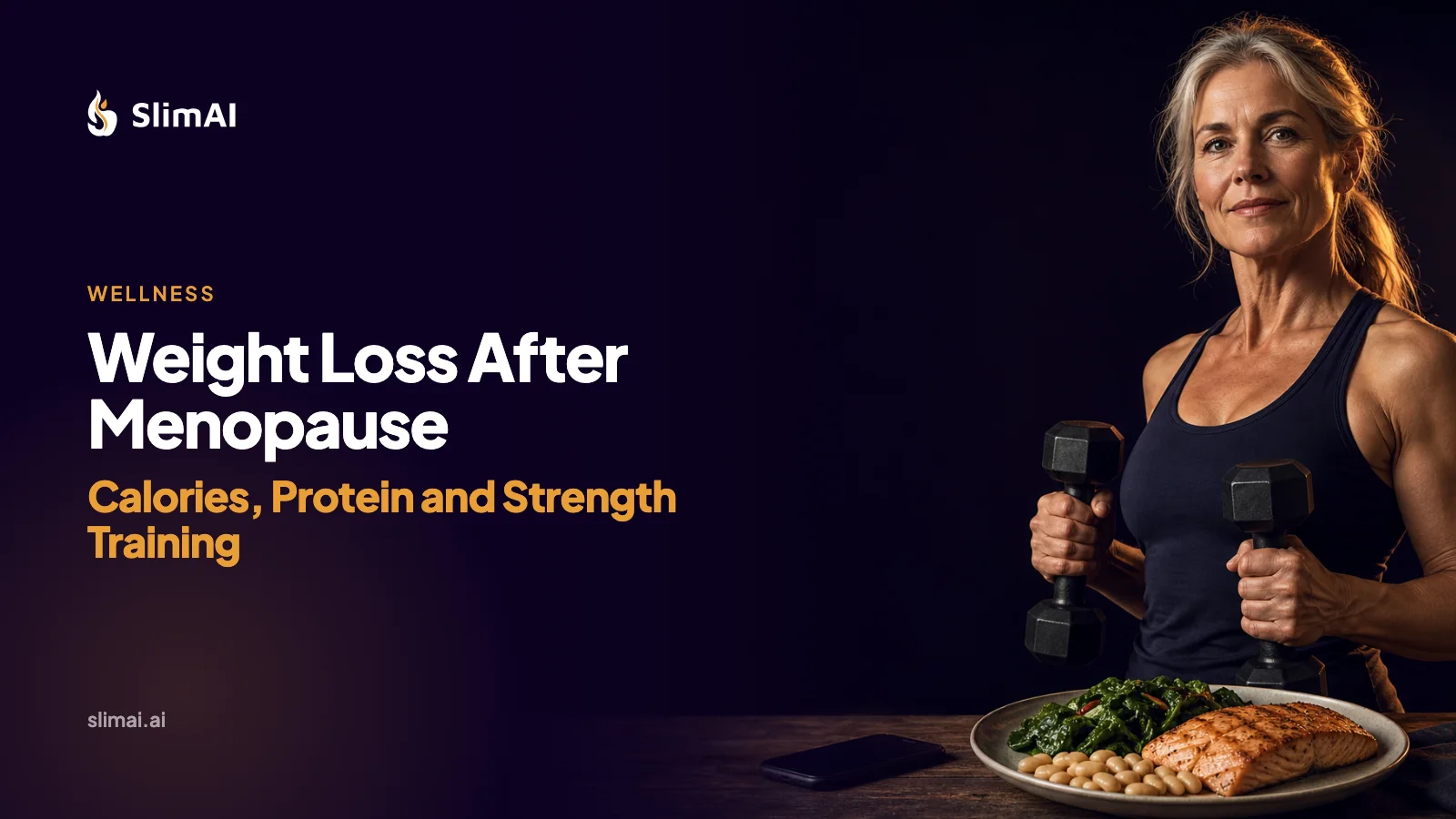
Weight loss after menopause still comes down to a calorie deficit, but your maintenance calories are lower because muscle declines and fat shifts to the belly. What changes is the recipe: a moderate deficit of 300–500 calories a day, about 1.0–1.2 g of protein per kg of body weight, strength training at least twice a week, and better sleep.
Many women eat and move the way they always have, and still gain weight in their late 40s and 50s. Most of that gain settles around the middle. It is frustrating, but it is not a sign that your metabolism is broken or that weight loss after menopause is impossible.
This guide explains what actually changes, how to set a calorie target that works, and why protein and strength training matter more now than at any earlier age. It is general information, so check any major change with your doctor, especially if you have a health condition or take medication.
Why does menopause weight gain happen?
Menopause weight gain is real, but it is slower and more gradual than many women fear. In the SWAN study, midlife women gained an average of about 0.7 kg (1.5 lb) a year, and that happened whether or not they had reached menopause yet. Mayo Clinic researchers report a similar average of about 1.5 lb a year for women in their 50s and 60s.
So aging, muscle loss, sleep and activity explain much of the gain on the scale. What the menopause transition changes most is where the weight goes. That is why many women notice menopause belly fat even when their weight has barely moved.
What changes in your body during menopause?
Estrogen falls, and fat moves to the belly
Before menopause, many women store fat mostly on the hips and thighs. As estrogen drops, more fat is stored around the abdomen, including the deeper visceral fat linked to heart disease and type 2 diabetes. Data from the long-running SWAN study of midlife women shows fat mass starts rising faster during the menopause transition while lean mass starts falling.
Muscle loss speeds up
Adults lose muscle gradually from their 30s, and the pace picks up around menopause. Less muscle means fewer calories burned at rest and in daily movement. It is one of the main reasons the portions that kept your weight stable at 40 can lead to slow gain at 55.
Metabolism is steadier than you think
A large 2021 study in Science that measured energy use in more than 6,000 people found metabolism, after accounting for body size and muscle, stays fairly stable from about age 20 to 60. So the drop in calories burned is mostly about losing muscle and moving less, which is good news: both can be changed.
Sleep and appetite get harder
Hot flashes and night sweats break up sleep, and short sleep raises hunger and cravings the next day. Lower energy also makes workouts easier to skip. Improving sleep is a real weight-loss strategy at this age.
How many calories should you eat to lose weight after menopause?
A calorie deficit still works. Hormones affect where fat goes and how hungry you feel, but weight loss still depends on eating fewer calories than you burn.
- Find your maintenance. Use a TDEE calculator with your current weight and an honest activity level.
- Subtract 300–500 calories a day. That usually means losing about 0.5–1 lb a week. For many women it lands around 1,500–1,800 calories a day.
- Avoid crash diets. Very low-calorie diets speed up muscle loss, which you are already fighting. They are also very hard to keep up.
- Recheck every 10–15 lb. As you lose weight, your maintenance drops, so your target needs to come down a little too.
Not sure how much to lose in total? Read how to choose a weight loss goal, and use the weight loss date calculator for a realistic timeline.
How much protein do you need after menopause?
The standard adult recommendation is 0.8 g of protein per kg of body weight a day, but many experts who study aging suggest about 1.0–1.2 g per kg for adults over 50 to protect muscle, and more if you are losing weight or training hard.
For a 70 kg (154 lb) woman, that is about 70–85 g of protein a day. Our protein calculator gives a personal number.
Two habits make it easier:
- Spread it across meals. Aim for 25–30 g at each main meal rather than a small breakfast and a large dinner.
- Use easy sources. Greek yogurt, eggs, cottage cheese, fish, chicken, tofu, lentils and beans all count.
Protein also keeps you fuller, which helps a deficit feel less like dieting. See how much protein you should eat per day for more detail.
Other nutrients that matter after menopause
- Calcium: 1,200 mg a day is recommended for women over 50, to support bone health.
- Vitamin D: 600 IU a day up to age 70 and 800 IU after, per NIH guidance.
- Fiber: whole grains, beans, vegetables and fruit help fullness, digestion and blood sugar.
- Alcohol: it adds calories, worsens hot flashes for many women and hurts sleep. Cutting back often helps more than people expect.
The best exercise for menopause weight loss
Strength training comes first
If you only add one thing, make it strength training. It protects muscle, helps bone density, and improves how your body handles blood sugar. US activity guidelines recommend muscle-strengthening work at least 2 days a week, covering all major muscle groups.
You do not need a gym. Squats to a chair, lunges, push-ups against a wall or counter, rows with a resistance band, and dumbbell presses all work. Use a weight that makes the last two or three reps of each set feel hard, and slowly increase it over weeks.
Then add walking or cardio
Aim for about 150 minutes of moderate activity a week, such as brisk walking, cycling or swimming. Daily steps are a simple way to raise calorie burn without a structured workout. The steps to calories calculator shows what your walks add up to.
How to track calories after menopause without obsessing
Calorie tracking is a tool, not a test. At this stage it is most useful for three things:
- Spotting portion creep. Small extras such as cooking oil, wine, snacks and larger servings add up and are easy to miss.
- Checking protein. Many women find they eat far less protein than they thought, especially at breakfast.
- Seeing trends. Look at your weekly average calories and your weight trend over 3–4 weeks, not one high day.
Track your waist as well as your weight. Because fat shifts to the belly, a shrinking waist can show progress even when the scale barely moves. The waist-to-height ratio calculator is a simple check. In perimenopause especially, bloating and water retention can hide fat loss for weeks; here is why weight fluctuates.
Menopause in South Asian women
Menopause often starts earlier for South Asian women. A study using India's national LASI and NFHS-5 surveys estimated an average age of natural menopause of about 46 years, from about 44 in Bihar to about 47.6 in Kerala, several years earlier than the roughly 51 years often quoted for Western countries. A 2021 meta-analysis of Indian studies put the average at 46.6.
That matters for weight and health in three ways:
- More years with low estrogen. Earlier menopause means muscle loss, belly fat and bone loss start sooner, so strength training and protein are worth starting in your early 40s.
- Higher risk at a lower weight. South Asian adults tend to develop type 2 diabetes and heart disease at a lower BMI than white Europeans. A "normal" BMI can hide a lot of belly fat, a pattern sometimes called skinny fat. The Asian BMI calculator uses the lower cut-offs recommended for Asian populations, and your waist measurement is worth checking too.
- It often goes unspoken. In many South Asian families menopause is rarely discussed, and symptoms such as poor sleep, low mood or weight gain are put down to stress or simply getting older. If symptoms affect your daily life, raise them with your doctor directly. You do not have to wait for them to ask.
Desi meals can fit every recommendation in this guide. Daal, chana, eggs, yogurt, paneer and chicken are good protein sources, and a balanced thali with half the plate as sabzi and salad keeps portions in check. Our Indian food calorie chart has numbers for everyday dishes.
How SlimAI can help
SlimAI is a calorie and macro tracker that keeps logging quick, so tracking fits around a busy life:
- Log by photo, voice or text. The AI estimates calories, protein, carbs and fat, and you can edit ingredients and serving sizes before saving.
- Pick a gentler pace. Choose a relaxed weight-loss pace instead of an aggressive one when you set your goal.
- Set your own targets. SlimAI Pro lets you set custom calorie and protein goals, for example a higher protein target your dietitian suggests.
- Watch the trend. Weekly charts show average calories, macros and weight over time.
SlimAI is not a menopause treatment or medical service. If you have symptoms that affect your daily life, talk to your doctor about your options.
Conclusion
Weight loss after menopause is possible, but the approach that worked at 30 needs updating. Your calorie needs are lower mainly because muscle declines, so a moderate deficit of 300–500 calories a day, about 1.0–1.2 g of protein per kg of body weight, and strength training at least twice a week work together. Track weekly averages and your waist, sleep as well as you can, and give changes a few months to show.
Sources and References
- Greendale GA, et al. Changes in body composition and weight during the menopause transition. JCI Insight, 2019 (Study of Women's Health Across the Nation, SWAN).
- Pontzer H, et al. Daily energy expenditure through the human life course. Science, 2021.
- Bauer J, et al. Evidence-based recommendations for optimal dietary protein intake in older people: a position paper from the PROT-AGE Study Group. JAMDA, 2013.
- The Menopause Society. Menopause and weight gain.
- U.S. Department of Health and Human Services. Physical Activity Guidelines for Americans, 2nd edition.
- NIH Office of Dietary Supplements. Calcium and Vitamin D fact sheets.
- Review of midlife weight gain in women, Current Obesity Reports, 2024 (summarizing SWAN weight-change data).
- Mean age at natural menopause in India estimated from NFHS-5 and LASI wave 1 data, and a 2021 meta-analysis of Indian studies (mean 46.6 years). See PubMed 33524647.
- Mayo Clinic. The reality of menopause weight gain.
This article is for general information and is not medical advice. Talk to your doctor before starting a new diet or exercise plan.